Geoffrey Carter grew up in Poughkeepsie, New York, the son of a chemical engineer. He took shop from Mr. Rushforth in seventh grade — soldering, threading iron pipe, making candle holders. He got into fistfights. He spent the summer of 1967 painting dormitory rooms alone with lead paint while "Light My Fire" played on the radio. He drove a garbage truck. He worked for a roofer. He helped his father change tires and change oil.
His introduction to classicism came through pain. A freshman art teacher put Jacques-Louis David in front of him — the great French Neoclassicist, The Oath of the Horatii, Roman columns, heroic figures — and something cracked open. While the professor droned, Carter stared at a table in the corner and thought: how would I build that? How is this attached to that? He started making things — a bow saw with a hand crank, jewelry boxes hacked from tree branches behind a garage in Kennett Square, Pennsylvania, the Mushroom Capital of the World.
The path after that was not prescribed. He drank in every bar from Lower Main Street to Arlington, near Vassar, near New Paltz, got three hours of sleep and went to work construction the next morning. He poured concrete forms for footings on a new bank in Sarasota with a crew from Georgia. He framed houses in Montauk and met Johnny Carson working on his redwood gate. He went to Goddard College. When it was over his parents didn't take him back — he lived in attics, friends' places, a chicken coop.
What carried him through all of it was people. The ones he worked alongside, drank with, learned from. That instinct — for showing up, for doing the actual physical thing with other human beings — is what built Sneaker's Gap.
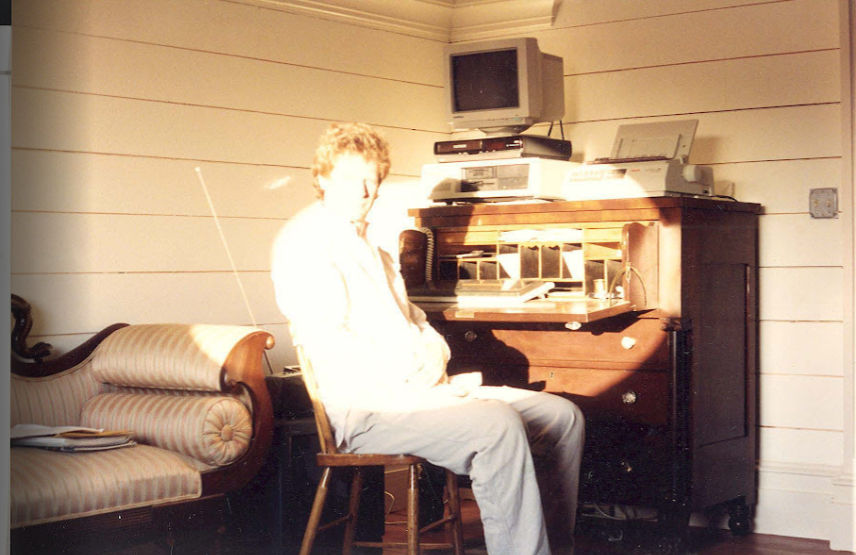
His father, Norman D. Carter, had worked at the Y-12 Plant in Oak Ridge, Tennessee — the oval electromagnetic separation facility that helped end the Second World War. He also helped with the plumbing at Sneaker's Gap. The range did not seem to trouble him.
Geoff is not a licensed architect. He is a man who learned to build because there was no other option, and then discovered he was very good at it.
This essay examines Sneaker's Gap, a Greek Revival house under long construction in Barrytown, New York, designed and built by Geoffrey B. Carter beginning in 1989, as a singular document in American architectural history. Drawing on a primary archive of 151 working drawings produced between 1987 and 1994, contemporary press coverage spanning 1995 to 2010, Carter's professional résumé and correspondence, the deed of purchase (December 15, 1986), and the broader scholarly literature on the American pattern-book tradition, vernacular classicism, and preservation theory, the essay argues that Carter's project constitutes the last known instance of a house designed by Geoffrey B. Carter and Stephen Falatko, AIA, and executed entirely within the epistemological framework of the early nineteenth-century builder-architect tradition — using Asher Benjamin's geometric proportional system, pre-industrial materials, and self-taught craft methods to produce a work of classical architecture that its historical models would recognize as structurally and aesthetically correct — and that drew national attention from leading experts in the field of preservation and classical architecture. The essay situates the project within the concurrent classical revival of the 1990s, the genealogical history of the Thomson family of New York builders, and the theoretical debate between classical design and classical construction that that revival largely failed to resolve.
"The whole idea of doing something original is so old now."
— Thomas Gordon Smith, Dean, Notre Dame School of Architecture, 1995Introduction: A House Out of Time
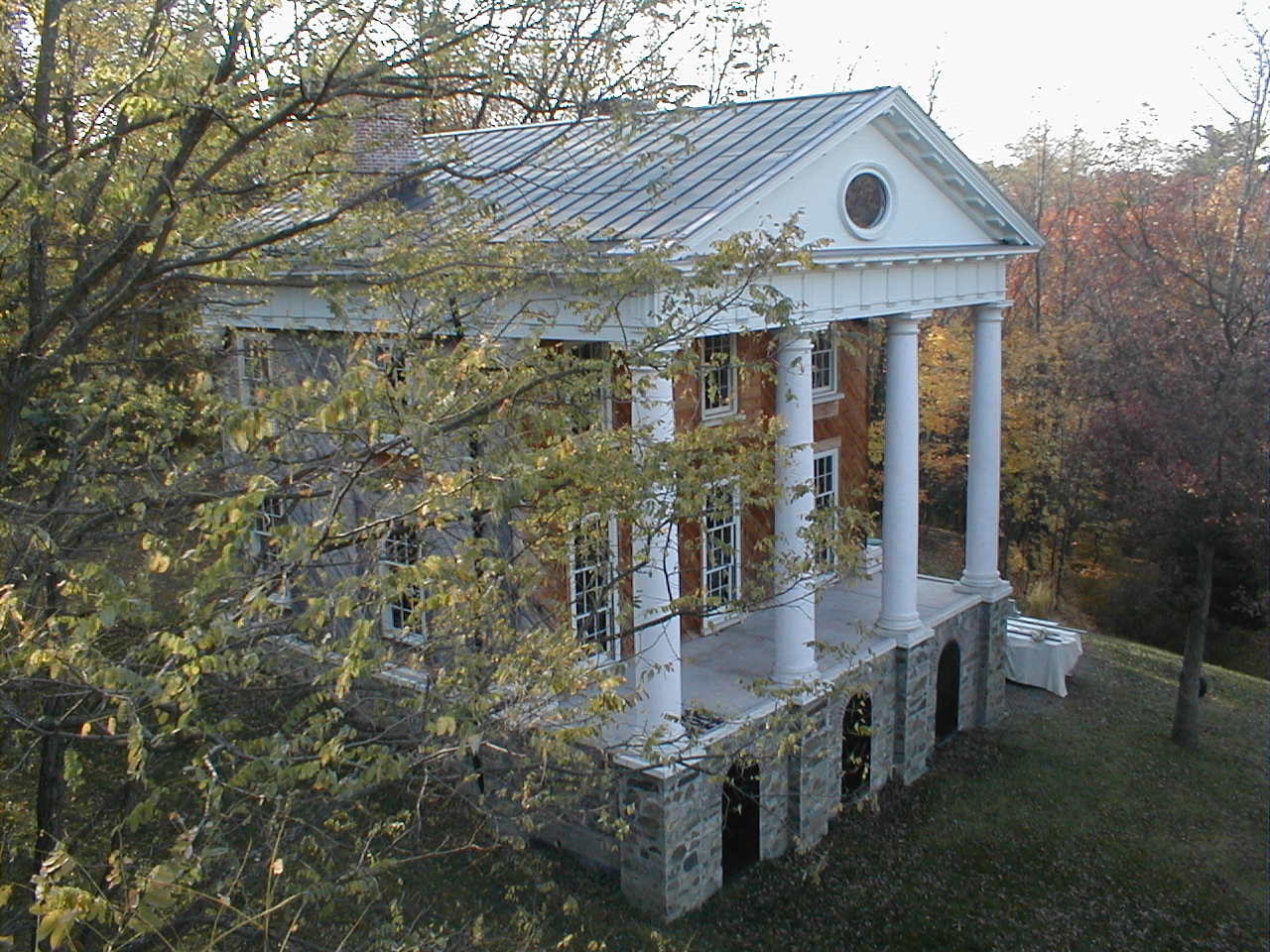
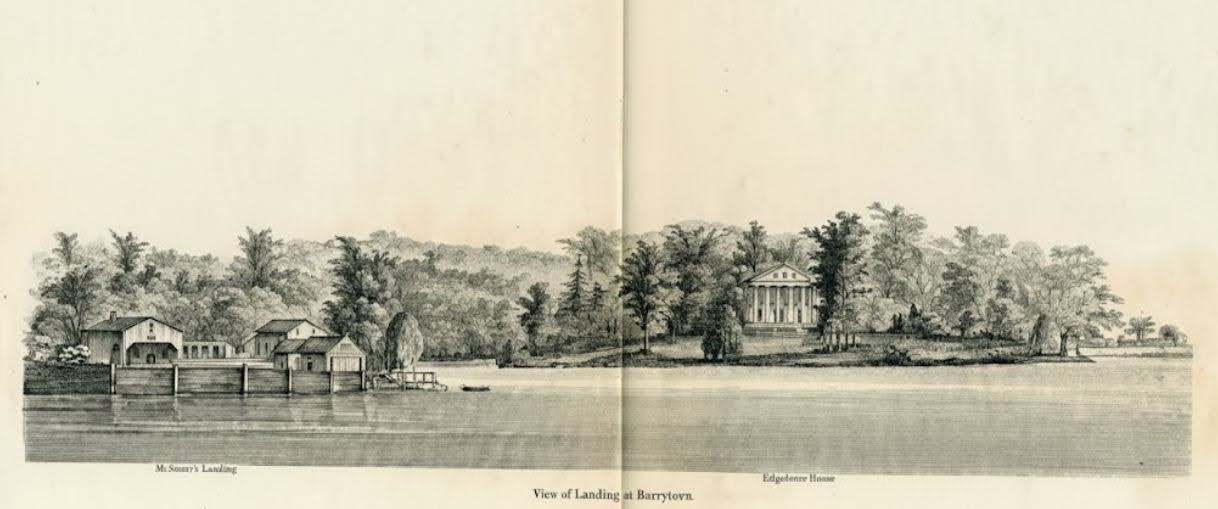
"Many believe it to be a historic ruin, not a new home."
— William L. Hamilton, "Sneaker's Gap," The New York Times Magazine, October 15, 1995On a cold Sunday in the autumn of 1995, a group of helpers gathered on a sloping lawn in Barrytown, New York, to sand triglyphs. There were sixty-three of them — the decorative blocks that punctuate the Doric frieze of a classical building — arranged on the grass like ancient fragments awaiting reassembly. They were not performing archaeological restoration. They were building a house. The house was not old. It had been under construction for six years, and the completion — as Carter understood it — was open-ended. The pleasure, he would say, is in the building. The man who had conceived it, drawn it, and with his own hands was making it rise from a Hudson River hillside was Geoffrey B. Carter, Director of Preservation and Physical Plant for Historic Hudson Valley at the time, an organization that had maintained some of the most significant Greek Revival houses in the northeastern United States. He knew, perhaps better than anyone alive, exactly what he was doing.
Weekend motorists slowed their cars on the county road that edged the property to gawk at what rose behind the lawn. Many believed it to be a historic ruin — a surviving fragment of the Greek Revival era that had swept Dutchess County in the 1820s and 1840s, producing a landscape of temple-fronted farmhouses and riverside estates that made it the most architecturally coherent valley in America. They were wrong, but they were not entirely mistaken. What Carter was building was not a copy of those houses. It was a continuation of them — not in the decorative sense that the word "revival" usually implies, but in the deeper and rarer sense of a resumption of the original practice, using the original tools, the original materials, the original intellectual framework, and the original proportional mathematics.
Carter had purchased the land — 2.250 acres on County Highway 82 in the Town of Red Hook, from Robert E. and Margaret Smith of Dock Road, Barrytown — on December 15, 1986, recorded three days later in the Dutchess County Clerk's Office at Liber 1729, page 610. He was living at the time at Hook Road, Rhinebeck, in the octagonal house he had already built after Orson Fowler's A Home for All — his first experiment in constructing a historical building type from its source document, using slip-form fieldstone technique he had learned from the writings of Scott and Helen Nearing. Jefferson's recurring interest in the octagonal form — Poplar Forest built on an octagonal plan, his own bedroom at Monticello an octagonal alcove — was not lost on a man who had already built one before visiting either. The deed of purchase carried a covenant prohibiting prefabricated structures on the property — a legal condition that happened to coincide exactly with Carter's own convictions about how the land should be built on. He bought the site two years before he opened the drawing set and three years before construction began. The interval was not delay. It was preparation.
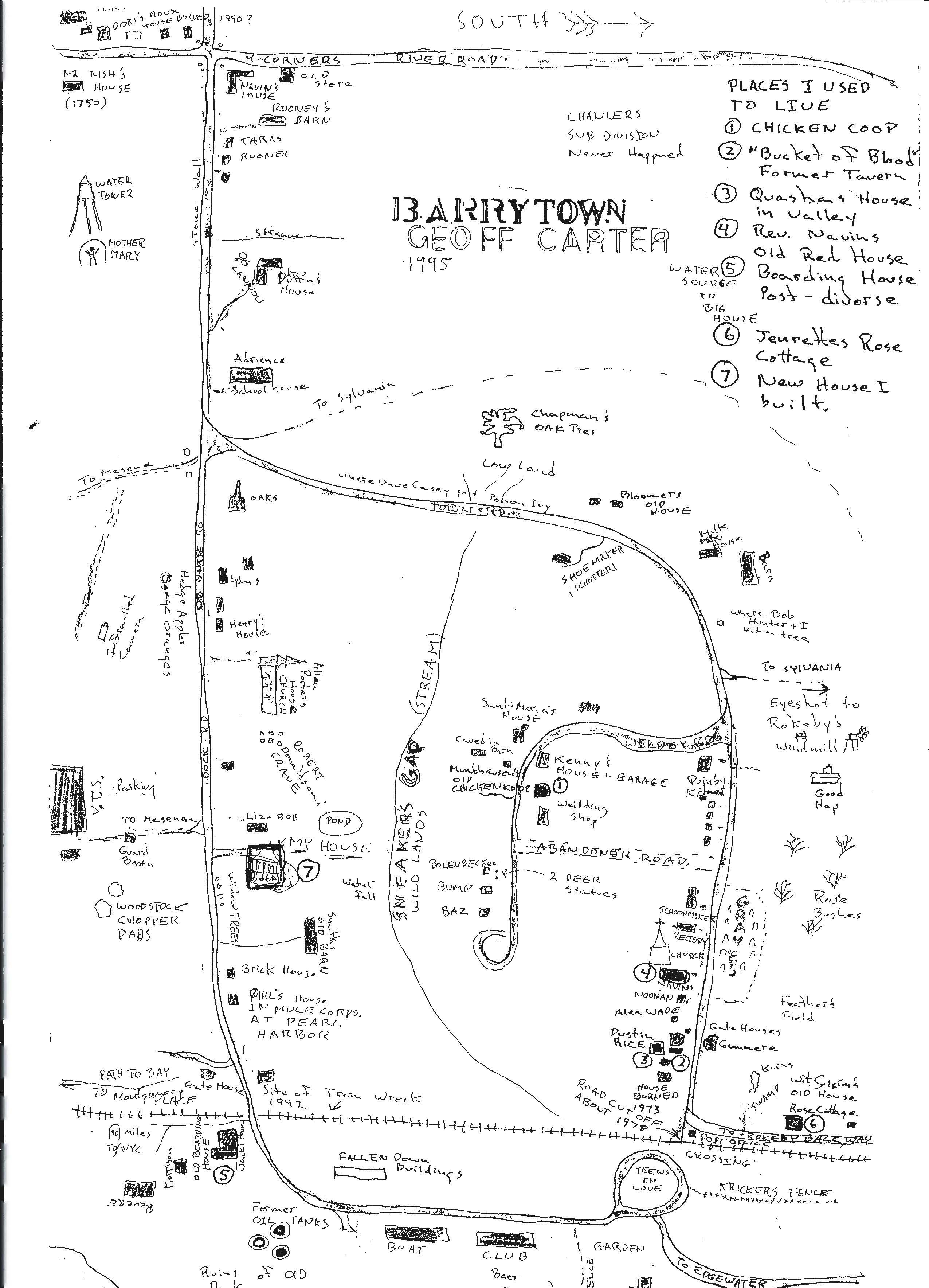
By the time Carter broke ground in 1989, he had been living continuously within the Barrytown landscape for the better part of a decade — in the Aldrich family's orbit at Rokeby; in the squash court at Montgomery Place while the octagon house was being built; in Jenrette's gatehouse on Station Hill Road; in one of the houses associated with the Quasha family's Station Hill Press, a structure known locally — though this is hearsay — as the Bucket of Blood; and eventually in the Rose Cottage on the Edgewater property, half a mile from the building site, and then in 1993 at Wilderstein — Margaret Suckley's house in Rhinebeck, where he lived alone for a year in the largely untouched Victorian house that FDR's closest companion had occupied until her death two years earlier. Carter had first seen Suckley on her front porch in the early 1970s, when her brothers were still alive. He had worked at the Roosevelt Museum in Hyde Park in 1984. Suckley had given her papers to the same archive. They had moved through the same world in different decades — and in 1993, while the columns at Sneaker's Gap were going up, he was sleeping in her house. Carter was not an outsider who had chosen a picturesque setting for an architectural experiment. He was a man of that landscape, known to everyone in it, who had been there long enough to have rebuilt Chanler Chapman's cottage at Sylvania — Chapman, a descendant of John Jay Chapman, whose son Robert burned it down smoking in bed — and to have hidden in a ravine from a fire truck.
That last incident deserves its own sentence. During the construction years, Carter was burning brush on the property one afternoon when his neighbor Phil Almsbach — a Navy veteran who had tended the mules at Pearl Harbor and would talk about it at length to anyone who would listen — called the fire department. Carter heard the truck coming and ducked down into the ravine. The Gap, that is to say, functioned as a literal sneaker's gap: a place of concealment, a passage between the visible world and the hidden one, exactly as the name had always implied.
Carter named the house "Sneaker's Gap" after the ravine that runs through the center of Barrytown — a local toponym whose etymology is contested but resonant. One tradition derives the name from the Dutch Snik, a small canal boat that hunters historically dragged through the ravine's waterway and concealed in the dense brush to bypass the river-access gates controlled by the great landed estates. A second connects it to the Depression-era use of the ravine as a transient camp: its proximity to the New York Central Railroad tracks made it a strategic disembarkation point, a concealed passage from the river-level tracks up to the hamlet, invisible to the estate guards at Rokeby and Montgomery Place. The name appears in print in The Barrytown Explorer (1958–1982), the local periodical edited by Chanler Chapman, resident of the adjacent Sylvania estate, who used "Sneakers Gap" to describe the informal boundary and ravine crossing separating his holdings from Rokeby. Carter knew Chapman personally: he had come to the Barrytown landscape through the Aldrich family at Rokeby. John Winthrop Aldrich, historian and descendant of the Armstrong/Livingston families of Rokeby, identified the Gap in his boundary research as a "natural break" in the ridge serving as a landmark in the social and legal geography of the Barrytown riverfront. The poet Robert Kelly, a Bard College professor whose verse maps the Barrytown landscape with unusual precision, has treated the Gap as a mythic threshold — a literal and symbolic passage between the world of the river and the world of the bluff. Carter built his house at that threshold, on a hillside overlooking the Hudson, at the edge of the ravine whose name he gave it — a name he had first encountered not in any archive but in the conversation of men he knew.1
This essay is an attempt to establish what that means, and why it matters. The argument proceeds in five movements. The first examines the American pattern-book tradition as an epistemological system and demonstrates that Carter's project is a direct and literally faithful continuation of that system. The second situates the project within Carter's professional identity as a preservation practitioner and his formation at Goddard College under David Sellers. The third traces the genealogical dimension of the project: the connection to Carter's great-great-great-grandfather Samuel Thomson, a New York City builder-architect of the first rank who worked alongside Ithiel Town and Minard Lafever, was a direct competitor with Alexander Jackson Davis on the Custom House project begun in 1834, and whose tools Carter inherited and whose proportional legacy he was, in a precise material sense, continuing. The fourth examines the documentary archive — 151 drawings produced between December 1987 and July 1994 — as a primary source for understanding both the design process and the collaboration with classicist architect Stephen Falatko, AIA. The fifth places Sneaker's Gap within the broader intellectual landscape of the classical revival of the 1990s, arguing that Carter's project resolves, in practice and in timber and in stone, a theoretical debate that the revival's academic wing never fully addressed: the distinction between classical design and classical construction.
The Pattern-Book Tradition: Proportion as Epistemology
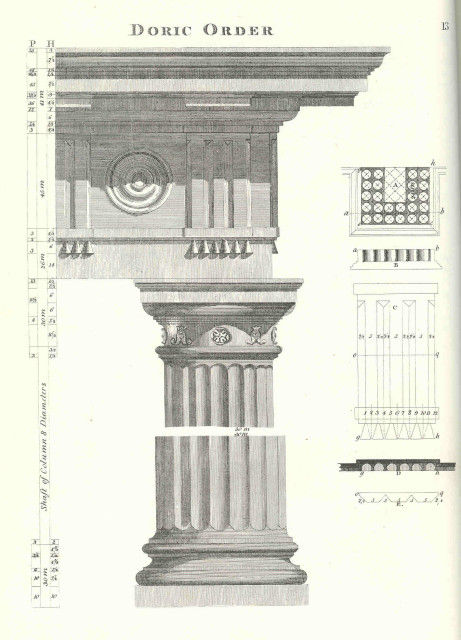
To understand what Geoffrey Carter did, one must first understand what Asher Benjamin did — and why it mattered. Benjamin's The American Builder's Companion, first published in 1806 and revised through six editions, the last in 1827, was not primarily a book of beautiful pictures. It was, in the precise sense of the term, a manual of intellectual procedure. Its central innovation was the translation of the classical orders — systems of proportion derived ultimately from Vitruvius and codified by the Renaissance theorists, most accessibly by Vignola and Palladio — into a series of geometric operations that any literate builder, regardless of architectural education, could execute correctly. The governing unit was the Module: one-half the diameter of the column at its base. Every other dimension in the composition — the height of the capital, the projection of the cornice, the spacing of the triglyphs, the overhang of the mutules — was expressed as a ratio of the Module. Given the diameter of the column, the entire building could be proportioned mathematically, without recourse to visual judgment or trained intuition.2
This was not a simplification of classical architecture. It was, in a deep sense, a democratization of it. The Greek temples that the early nineteenth century was attempting to revive had themselves been products of a proportional system — the Greek orders were never purely visual, but always mathematical, their beauty arising from the same geometric logic that Benjamin was encoding for American carpenters. What Benjamin understood, and what his successors in the pattern-book tradition (Minard Lafever, Edward Shaw, others) extended, was that the architecture of democratic America required a mode of transmission different from the European atelier. The atelier trained the eye through years of drawing and measuring historical examples. The pattern book trained the mind through the direct application of mathematical formulas. Both produced buildings in the classical tradition. Only one was available to a self-educated man in Dutchess County, New York.
The drawing catalog for Sneaker's Gap documents, with a clarity unusual in any architectural archive, the moment at which Carter entered this tradition. Drawing 130 is dated December 4, 1987
— the earliest dated drawing in the entire set, produced five weeks before Carter formally opened the drawing project on January 3, 1988. It is a large-scale study of cornice and column base profiles, executed at 3/4" = 1'-0" scale. The title block reads, in Carter's own hand, "Emasculated Details" — a characteristically precise self-assessment suggesting he knew the drawing was preliminary, that he was working toward something fuller. Carter was studying the orders before he began designing: entering the tradition intellectually before entering it constructively.
Early design study dated December 4, 1987 — one of the earliest dated drawings in the set, predating the January 1988 title blocks. Large-scale cornice profile and column base profile sections. Title block lower right: "Dec. 4, 1987 / Scale 3/4"=1' / Emasculated Details." The word "emasculated" suggests Carter viewed this as a simplified or preliminary version. Confirms Carter was studying the classical orders in detail five weeks before formally opening the drawing set.
The West Elevation title block — Drawing 57, dated January 3, 1988, the earliest architectural drawing proper — was followed within nine days by the East Elevation title block (Drawing 58, January 9, 1988) and within nineteen days by the Second Floor Plan (Drawing 68, January 22, 1988). Carter was producing elevations and floor plans simultaneously, as a builder-architect of the early nineteenth century would have done — not working from a designed exterior toward a planned interior, but developing the composition on all axes at once, as the proportional system required.
The critical document in the archive for understanding Carter's relationship to Benjamin is Drawing 49: a comprehensive working sheet combining water table detail, column base and capital profiles, porch floor construction, plinth block relationships, and pilaster alignment, all derived by completing the book's geometric formulas. The West Portico specification sheet (Drawing 103) records the governing translation: "One Minute = .443 or 7/16"." This single annotation is among the most historically significant in the set. Benjamin's system, like Vignola's before it, expresses all measurements in minutes — subdivisions of the Module. By establishing his own minute as 7/16", Carter fixed the absolute scale of his classical composition: every molding projection, every capital dimension, every frieze element across the entire building followed from this single conversion factor. The house was, in a mathematical sense, fully determined from this moment.
Two-part sheet combining a specifications table with a partial West Elevation drawing. Specifications: One Minute = .443 or 7/16"; Height of Order: 24'; Height of Column: 19'11-1/4"; Height of Column Shaft: 17'8-1/16"; Diameter at Base: 2'2-9/16"; Diameter at Neck: 1'10-1/8". The governing translation fixing the absolute scale of the entire classical composition.
The field notes sheet (Drawing 41) makes the intellectual genealogy still more explicit. Working notes on cornice installation methodology include the instruction: "Draw projections and heights like Asher Ben did substituting minutes for real heights." Carter is not merely using Benjamin's book as a reference. He is thinking in Benjamin's conceptual vocabulary, substituting his own absolute measurements into Benjamin's relational system precisely as Benjamin had instructed. The historical parallel is exact. When a Hudson Valley carpenter in 1835 opened The American Builder's Companion and began proportioning a Greek Revival farmhouse, he was performing the same intellectual operation Carter was performing 150 years later. The tradition had not been transmitted. It had been recovered — from the same source, by the same means.
"They were designed for people like me," said Carter, who is untrained as an architect. He sized the house's various components by completing the book's geometric formulas. Because every part is calculated, 'the design was pretty much automatic.' The very top of the cornice is the top of the order; the bottom of the order is the base of the portico column. Everything in between is proportioned. It's incredible to me that they could pack it into ten sentences."
— Geoffrey Carter, quoted in William L. Hamilton, The New York Times Magazine, October 15, 1995
The pattern book tradition was not, of course, monolithic. Benjamin's Doric order was a Roman Doric — derived from Vignola rather than from the Greek sources — which is why the column in his system has a base, unlike the pure Greek Doric column that sits directly on the stylobate. Carter understood this distinction and built accordingly: Sneaker's Gap is a Roman Doric house, its columns resting on the attic bases that Benjamin specified, its proportions governed by the Roman modular system. The comprehensive working study sheet (Drawing 114), which combines cornice, capital, and base sections on a single large-format drawing, shows every molding profile of the complete column order worked out in its final dimensions.
The question of what made the pattern book tradition work — and what made it stop working — is directly relevant to Sneaker's Gap. Benjamin's system functioned because it was embedded in a broader craft culture that could execute what the book specified. When the craft culture collapsed — driven out by mass-produced millwork, by the proliferation of synthetic materials, by the de-skilling of residential construction that accelerated through the mid-twentieth century — the pattern books became historical curiosities rather than working documents. There was nothing emasculated about the formulas. What had been emasculated was the constructional knowledge required to execute them.3
Carter had written, in his own philosophical notes, a formulation that placed his project within the longest possible historical frame: "It is harder to restore an old building than to build a new one because greed dominates patience." This is not a statement about preservation policy. It is a statement about what the pattern-book tradition required — and what its disappearance cost. As Martin Filler documented in his feature on Sneaker's Gap in House & Garden (November 2002), Carter had spent nearly a dozen years moonlighting on what Filler described as "a restoration scheme of his own" — not saving another old house, but building a new one in which the principles and techniques of classical architecture as it was practiced two centuries ago could be fully restored. "Today, building essentially consists of taking different components that are manufactured all over the world and putting them together as a finished product," Carter told the magazine. "There's just no consistency or quality. I'm much more attracted to the wholesome architecture that worked for centuries. There's got to be a reason why people keep returning to classical form."4
Formation: Sellers, Goddard, and the Preservation Years
"The best way to learn is to take something apart and put it back together. I had done so much of that that I knew how an old house was built."
— Geoffrey Carter, quoted in Karin Bolender, "A Labor of Love," Rhinebeck Gazette Advertiser, April 2, 1998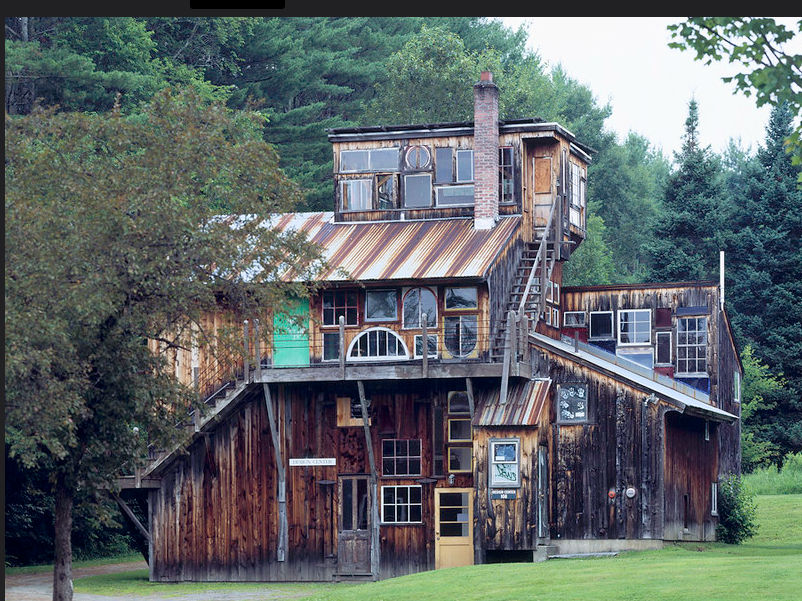
Carter's formation as an architect — a title he would not claim, but which the quality of his drawing set makes difficult to withhold — was entirely experiential. He attended Goddard College in Plainfield, Vermont, where he studied in the Design and Construction Program directed by David Sellers — Yale-trained architect, founder of the Prickly Mountain design-build community in Warren, Vermont, and the figure credited with developing the first design-build curriculum in American architectural education. Sellers' conviction that the architect's authority derived from constructional knowledge rather than academic credential, and his practice of building alongside craftsmen rather than directing them from an office, were the pedagogical framework within which Carter's own philosophy of making took shape. His other tutors at Goddard included, in poetry, Louise Glück — who would receive the Nobel Prize in Literature in 2020. Carter was simultaneously learning to build and learning to attend to language with the same precision he brought to material: the two disciplines, in retrospect, are continuous in his work.5

After Goddard, Carter worked in residential construction in the Hudson Valley — building all the shutters for Oak Hill Mansion in Linlithgow, New York, associated with the Henry Livingston family, and working at Steen Valetje, the Delano family estate in Rhinebeck where FDR’s cousins had grown up — before operating his own contracting business and millwork shop from 1984 to 1986, specializing in the reproduction of architectural millwork and the manufacture of architectural components, cabinet making, and stair building. In 1984 he worked at the Franklin D. Roosevelt Museum in Hyde Park, fabricating and installing exhibitions for the north gallery. He joined Historic Hudson Valley in 1986 as Project Supervisor for the Restoration of Montgomery Place — a four-year, $6.5 million project transforming the private estate into a publicly accessible site, supervised with architects John Mesick of Albany and Beyer Blinder Belle of New York. In 1990 he became Director of Preservation and Physical Plant, with responsibility for 57 buildings across two counties, including surrounding landscapes and security systems.
In September 1988 — the same autumn the first Sneaker's Gap drawings were being made — Carter made a trip to Charlottesville, Virginia, facilitated by William D. Reiley, a landscape architect based there who appears in Carter's contacts. The trip took in three of the most significant Jefferson sites in the country: the University of Virginia, where Carter studied Pavilion No. 1 and No. 10 at close range; Monticello; and Poplar Forest. Carter wrote afterward that the experience was "heartening." Correspondence followed with William Beiswanger at Monticello and Lynn Beebe, Executive Director of Poplar Forest. Carter visited Poplar Forest on a closed day by special arrangement, finding it in what he described as "a particularly exciting phase — untouched," before restoration had begun. A working preservationist making a systematic study of Jefferson's constructional solutions while drawing his own classical house in Dutchess County: the formation and the project were simultaneously crossing the threshold from study to physical intervention.
His subsequent career at Historic Hudson Valley gave him access to buildings of extraordinary quality. He served on the advisory board of Wilderstein Preservation in Rhinebeck — the Suckley estate — alongside Richard Crowley, who was simultaneously advising him on the Sneaker's Gap column arrangement. He supervised the restoration of the Swiss Factory Lodge, designed by A.J. Davis, at a cost of $400,000; the installation of new infrastructure and utilities at Montgomery Place for $1.1 million; the complete revitalization of Phillipsburg Manor for $5.6 million; infrastructure work at Van Cortlandt Manor for $1.5 million; landscape restoration at Sunnyside for $1.9 million; and roof and structural repairs at Locust Grove. His role was not curatorial but operational. He had professional responsibility for the physical integrity of some of the most significant Greek Revival domestic architecture in the country, and he oversaw the work with in-house crews of twenty-seven people.
This is an unusual formation for a designer. Most architects of the classical revival that emerged in the 1980s and 1990s had been trained in the academy. Their knowledge of classical architecture was, in the first instance, visual and theoretical: they had learned to draw the orders, to understand the precedents, to design compositions that quoted or extended the tradition. What they had rarely done — what the academic context could not provide — was take a Greek Revival house apart: to understand the constructional logic from the inside, to know what the original builders knew about how a Doric entablature was assembled piece by piece, what the sequence of installation required, where the critical junctions were, how the cornice met the rafter tail.
Carter knew all of this. The drawing catalog proves it at every level of resolution. The roof detail sheets (Drawings 19, 54, 92) specify the junction of classical cornice and structural roof framing with the authority of someone who has stood inside that junction in a building undergoing repair. The porch floor detail (Drawing 43) resolves the floating deck construction and water table relationship with precision — noting that the porch frame is set lower than the house frame to direct water away from the column plinth blocks. The field notes sheet (Drawing 41) records the installation methodology for the cornice: "Use bracket system to hold cornice etc. Use style and rail construction on soffit with slideable rails to locate while under construction." This is not the language of design. It is the language of installation.6
Carter's published professional writing during the construction years demonstrates the integration of his preservation practice and his building project at the level of technique. His article "The Restoration of the East Portico at Montgomery Place," published in Fine Homebuilding in June 1990, appeared while the Sneaker's Gap foundation walls were going up — a craftsman writing about restoring a classical portico at exactly the moment he was building one. The article belongs to both projects simultaneously: it is a technical document for the restoration, and a research document for the construction. There is, in Carter's practice, no meaningful separation between the two.
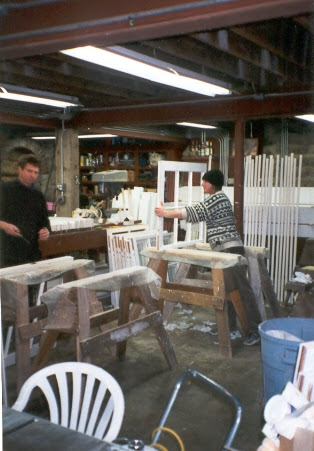
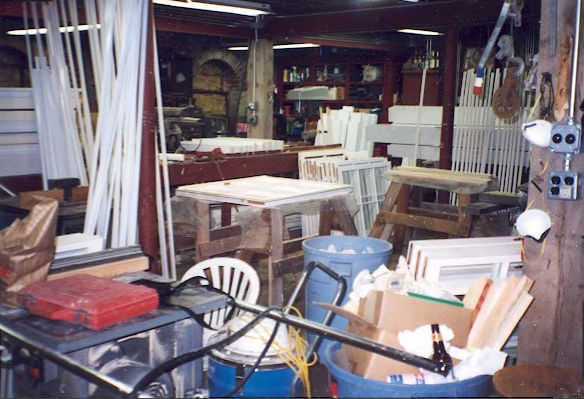
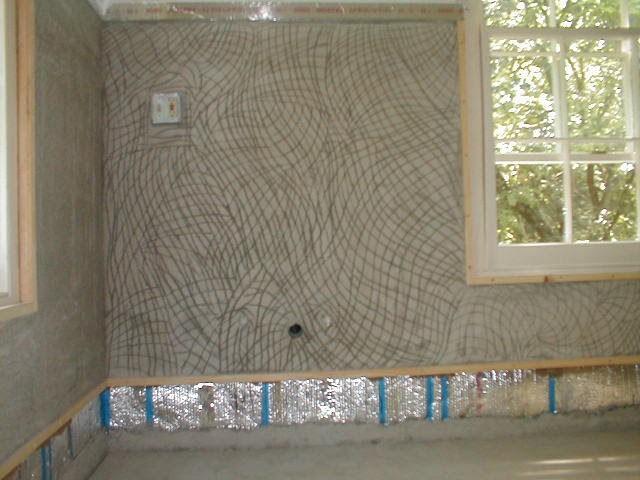
The foundation system is perhaps the most dramatic evidence of Carter's constructional intelligence. The slip-form fieldstone technique Carter applied to the foundation walls — learned from the writings of Scott and Helen Nearing, the Vermont homesteaders whose Living the Good Life (1954) documented their own slip-form stone construction, and first practiced by Carter on his Rhinebeck octagon house — is documented in five color-coded drawing sheets (Drawings 93–96, 108–109) that constitute a complete engineering document for the system. The technique had no living practitioner in residential construction to consult. Carter not only revived it but systematized it into a color-coded lumber schedule of extraordinary completeness. The July 1990 wall form plan (Drawing 109) is the master layout diagram coordinating the entire slip-form construction sequence across all four walls, all corners, and all four portico column base locations.

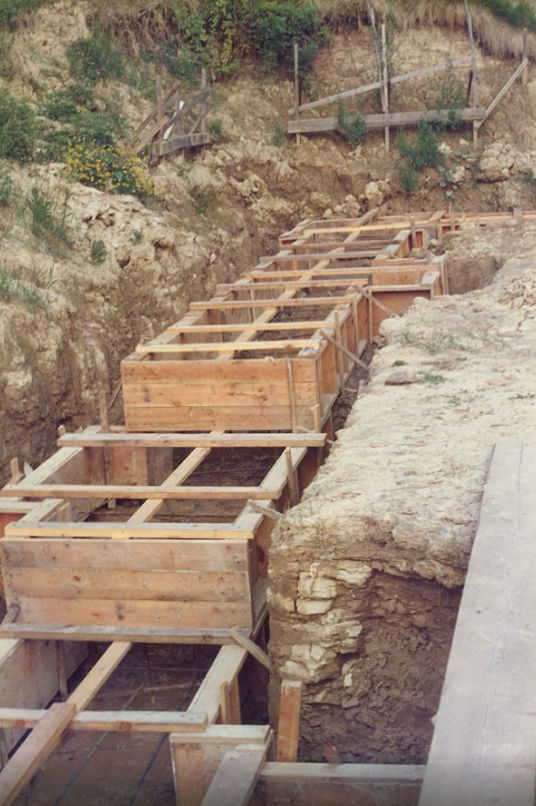
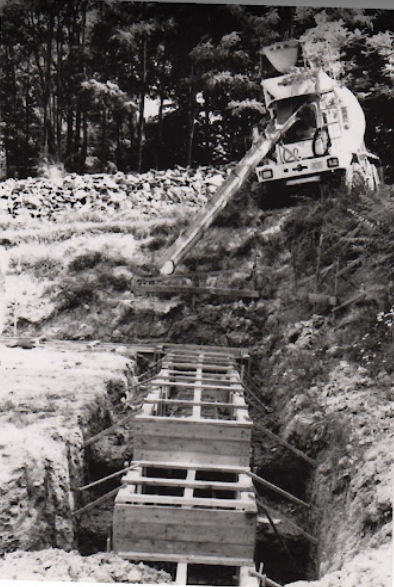
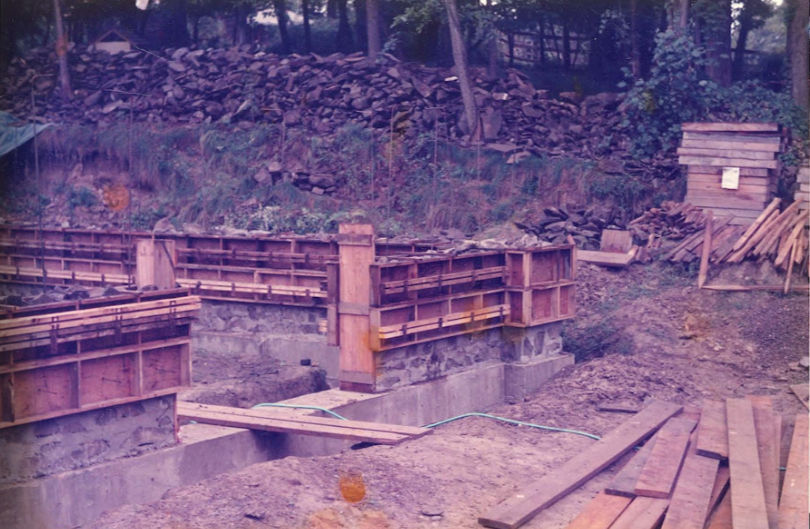
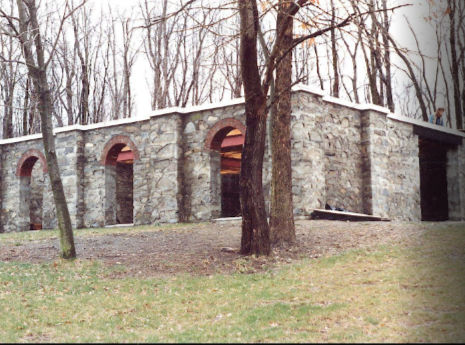
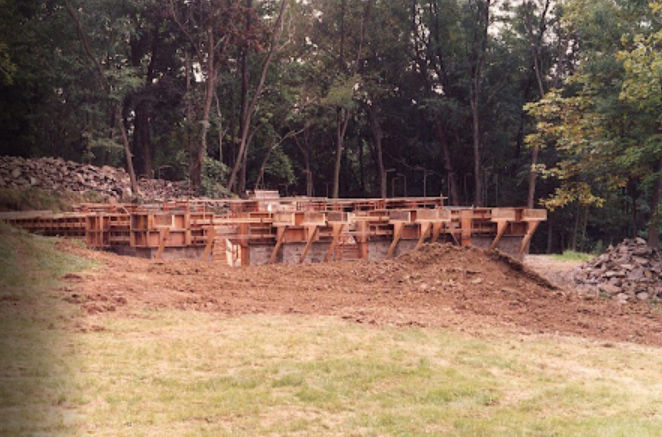
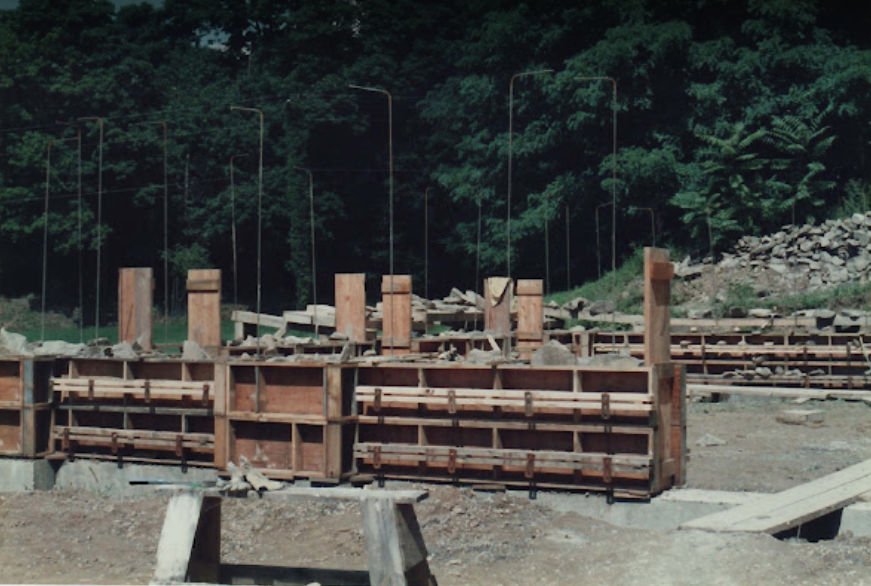
A suite of five color-coded foundation construction drawings constituting a complete self-invented engineering document for the revival of the slip-form fieldstone wall technique. Color Code Schedule: A (blue) = 8' standard boards, 34 units; B = 3' boards, 44 units; C = 3'4.5" corner pieces, 8 units; D = 10" connector blocks, 48 units; through type I = 1'10.5" special pieces, 2 units. Complete lumber takeoff: 504 studs total. The most quantified documents in the set — the materials order for a construction technique with no living practitioners.
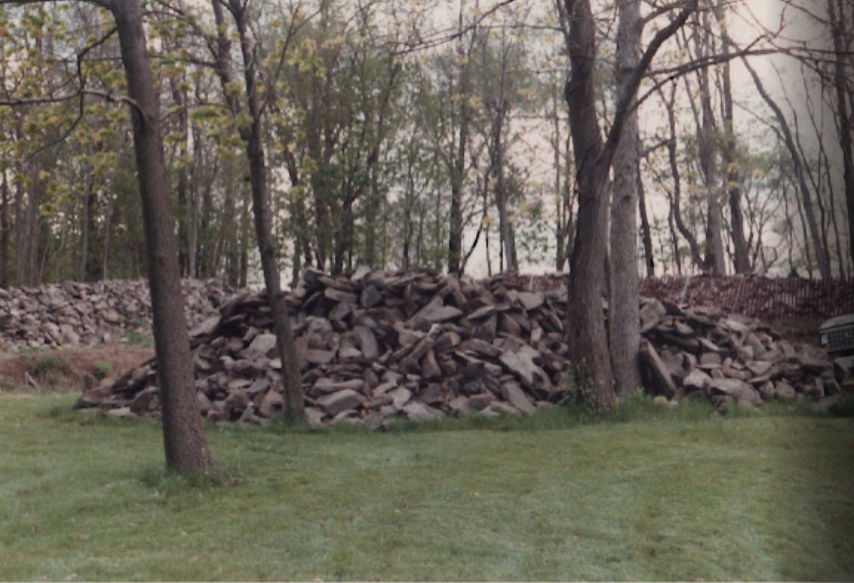
The fieldstone itself came from a field in Rhinebeck, four miles away. Carter made sixty-seven round trips to fetch enough for the foundation. Karin Bolender, writing about Sneaker's Gap in the Rhinebeck Gazette Advertiser (April 2, 1998), captured the significance of this correctly: "Carter believes that a house, like any other project, will only return what is put into it."
.jpg)

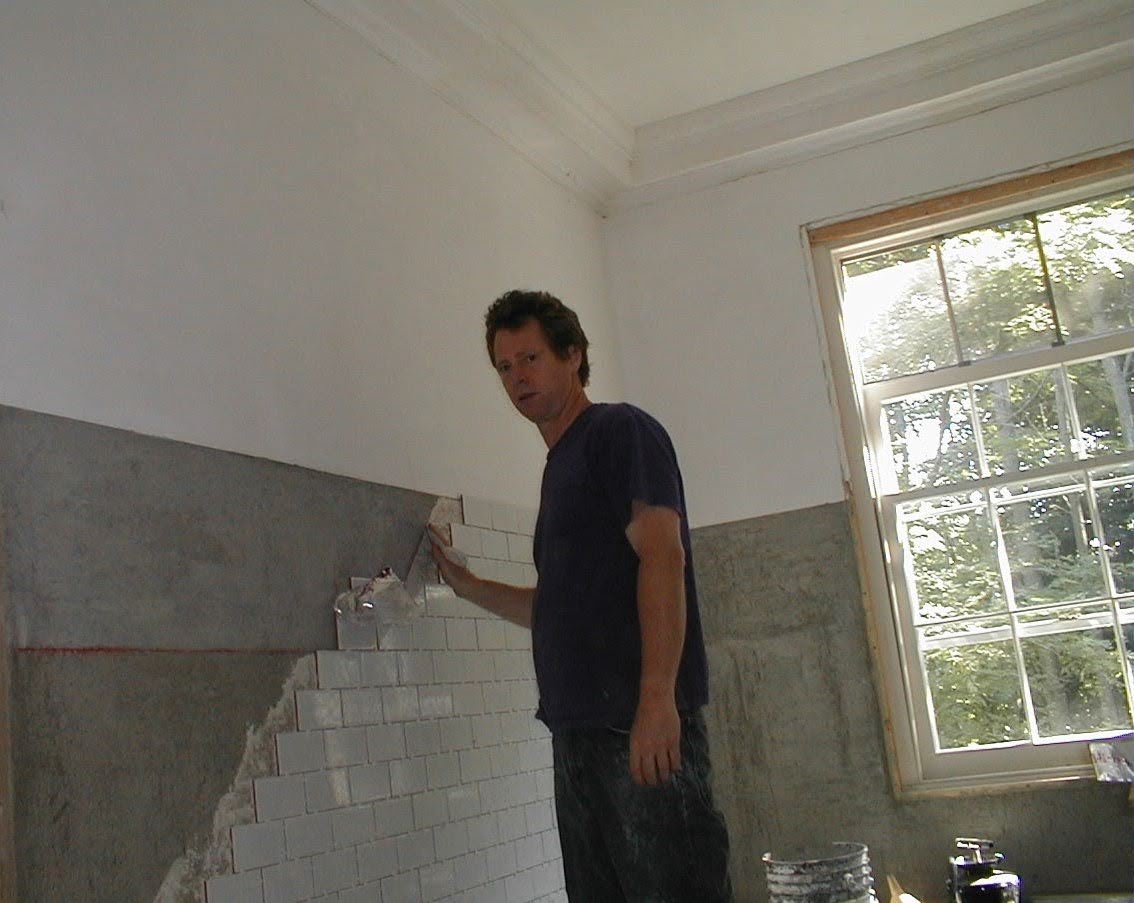
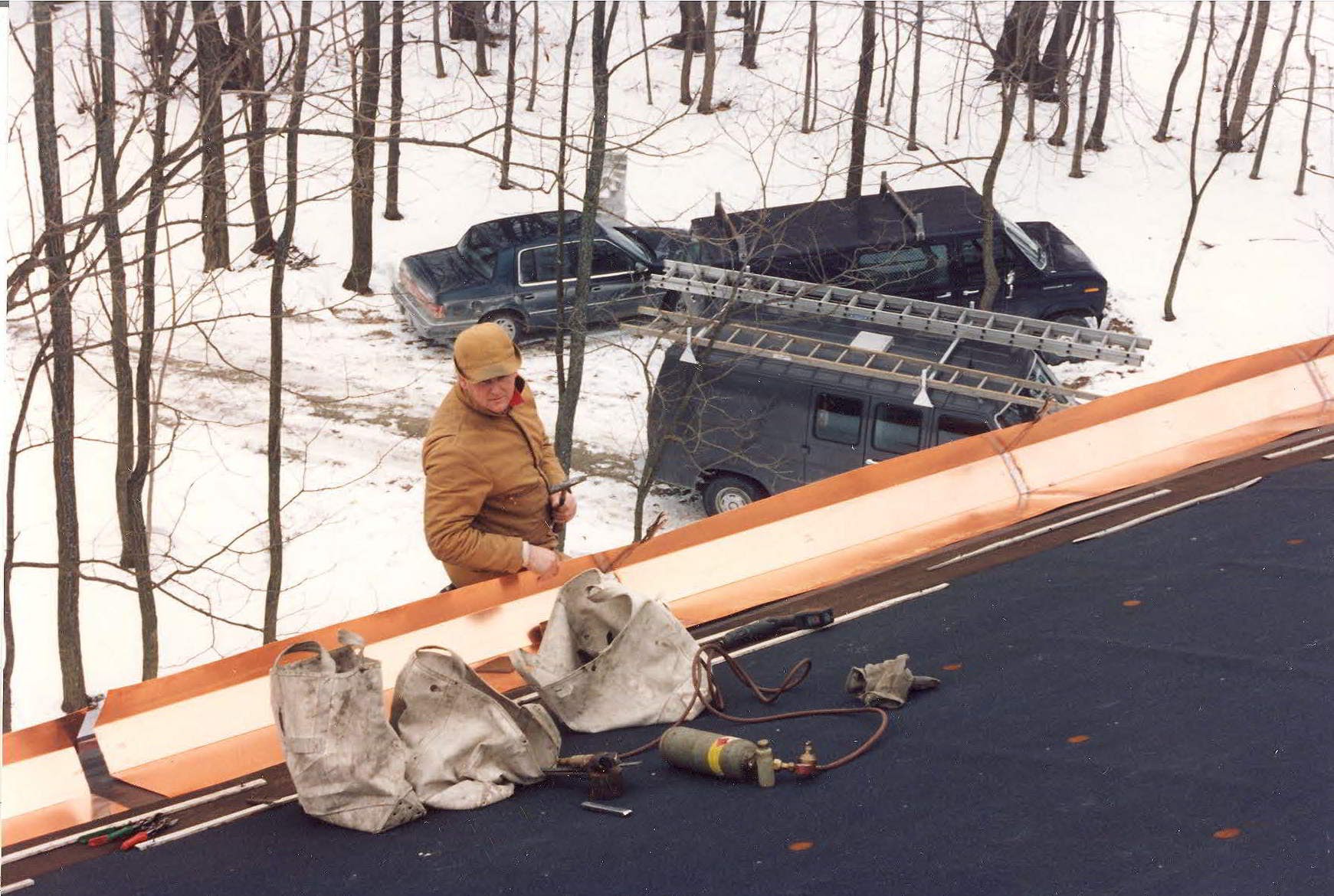
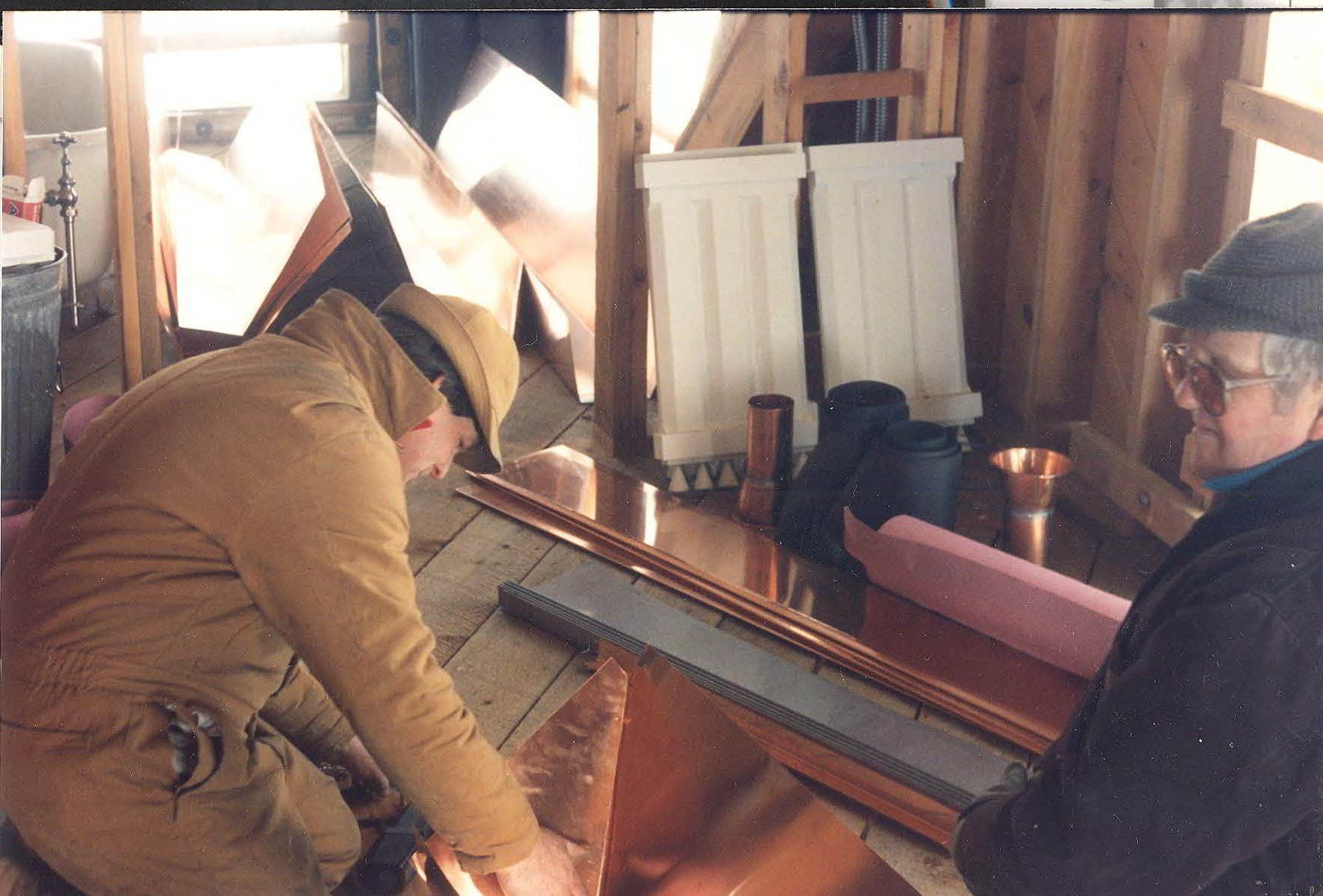
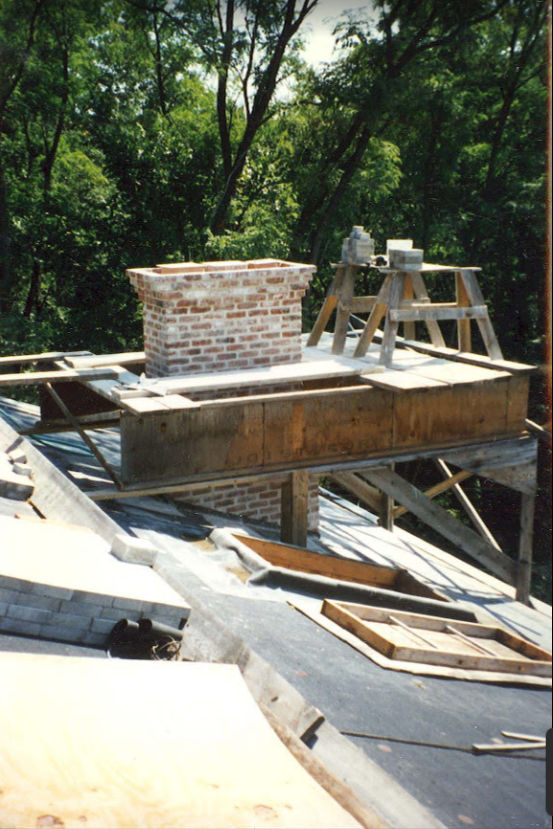
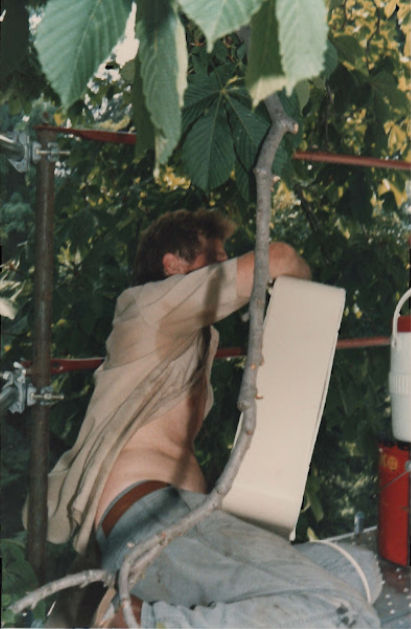
 Scaffolding for frieze.jpg)
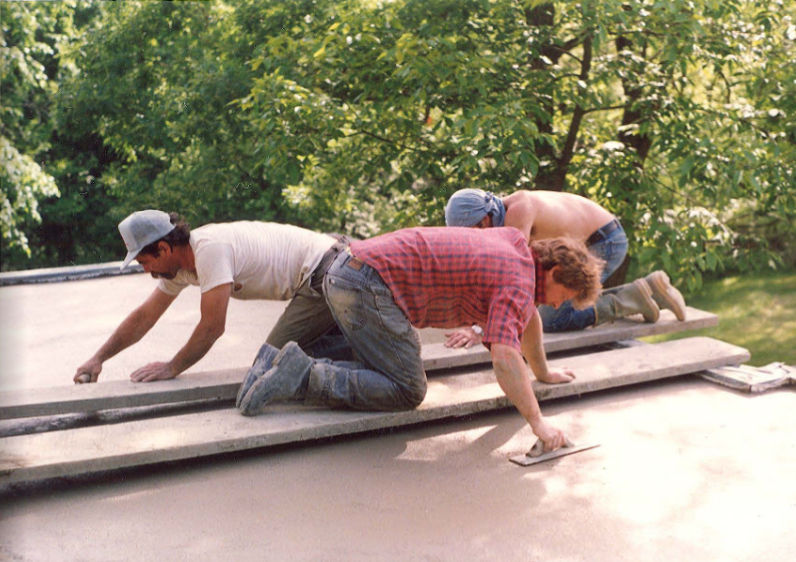

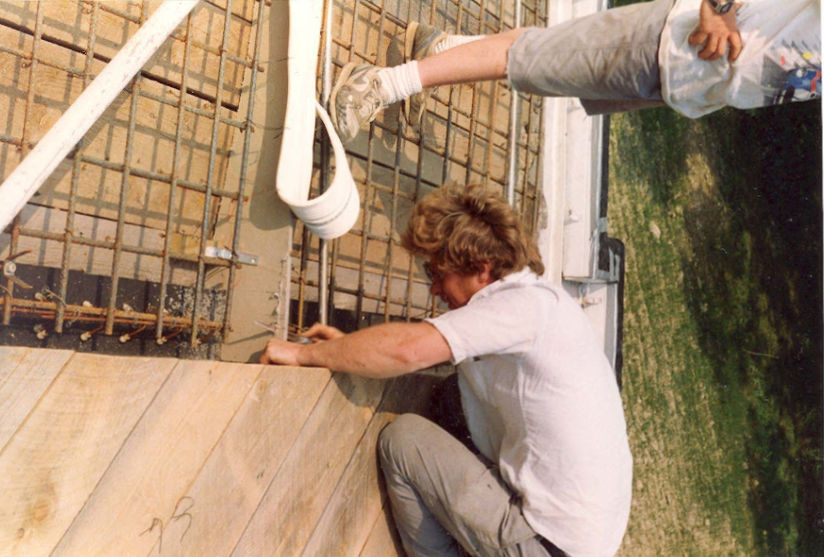
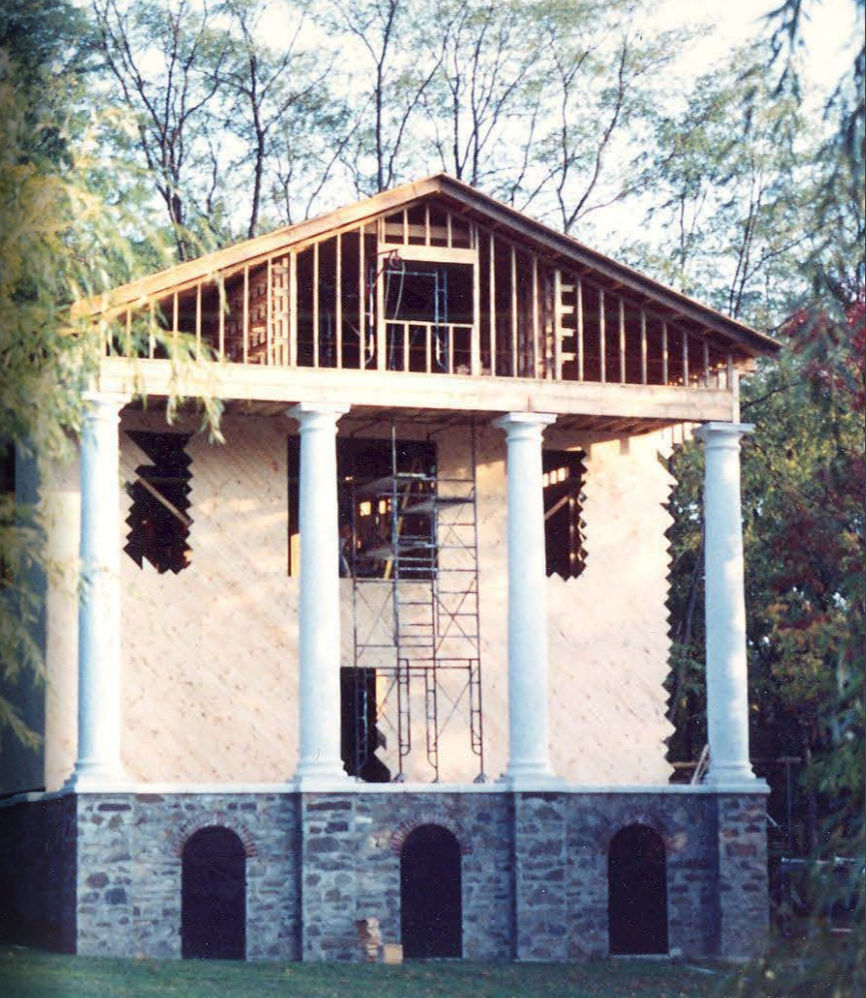
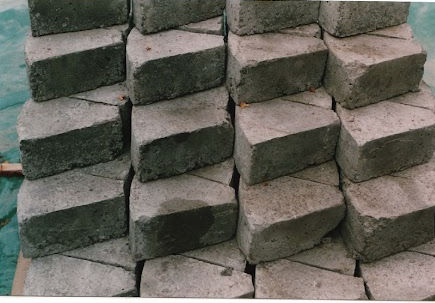
A building whose materials were harvested from the landscape four miles away, whose foundation walls were laid by hand using timber forms, whose columns were built up from 1,800 concrete bricks cast one batch of eighty at a time — such a building carries a different kind of knowledge than one assembled from standardized components. The knowledge is distributed across the building's fabric. It is legible to anyone who knows how to read it.
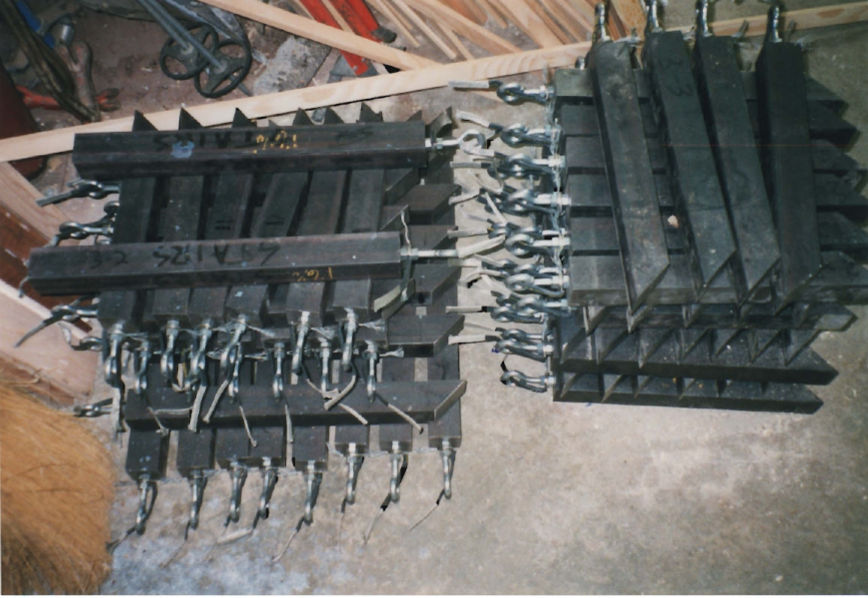
The Institute for Classical Architecture and Art's Hudson Valley excursion article (December 2009) captures the relationship between Sneaker's Gap and the great Hudson Valley estates most precisely.
The tour that day visited the Vanderbilt Mansion, the Mills Mansion, Edgewater, and Astor Courts — four of the grandest expressions of classical architecture in the valley. Carter's house, described as "a modern-day work in progress, inspired by early Greek Revival designs," appears between the Mills Mansion and Edgewater in the itinerary — positioned, correctly, as a continuation of the same tradition, different in scale and means but not in principle. The article notes that Carter "began construction of this house in 1989, using only construction techniques of the early 1800s, with no synthetic building materials," and documents Carter showing visitors to Sneaker's Gap his basement millwork operation, where he was producing all the interior trim himself.
The 1998 Rhinebeck Gazette article captures the broader significance of this material and genealogical continuity with unusual precision. The author, Karin Bolender, notes that Carter was drawing the plans for the exterior of the house by following the instructions for composing a Roman Doric order in the 1827 edition of Benjamin's American Builder's Companion — the same edition, or its direct textual predecessor, that Thomson would have known and used. "Carter also considers his work a contribution to the continuity of the history of this part of the valley. He believes that local building styles can reinforce community, like a piece of sewing, by threading the past into the present." The Gazette is a local paper, not an architectural journal, but this formulation is precise: not a copy of the past, not a quotation of it, but a thread — a literal continuation of the same fiber.
The visitors Sneaker's Gap attracted during the construction years constitute a roster that makes the project's standing in the preservation and cultural world legible at a glance. Richard Hampton Jenrette — founder of Classical America, owner of Edgewater and Milford Plantation, one of the most consequential private preservationists of Greek Revival domestic architecture in America — had known Carter since the octagon house years, when Jenrette would drive to Rhinebeck to visit him there. Carter subsequently lived for seven years in the Rose Cottage on the Edgewater property, half a mile from the Sneaker's Gap building site. Jenrette walked from Edgewater to Sneaker's Gap repeatedly throughout the construction years; he loved the house and wanted to see it finished. Carter did multiple preservation projects for Jenrette over the course of their twenty-year friendship, and spent a week with him at Milford Plantation in Sumter County, South Carolina — one of the supreme Greek Revival houses in America, six giant Corinthian columns, considered among the finest Greek Revival interiors in the country — before Jenrette purchased it, evaluating the house professionally and staying at the mansion. They spent evenings on the front porch at Edgewater with Jenrette's friend Bill Thompson, an interior designer, drinking and talking — and on one of those afternoons Carter witnessed Jenrette pick up the telephone, call Laurance Rockefeller, and then turn and give Carter a wink, as if to say: how's that one for you.
John Dobkin — director of the National Academy of Design from 1978 to 1989, and from 1990 president of Historic Hudson Valley, which made him Carter's direct superior — visited Sneaker's Gap multiple times. Joan K. Davidson, president of the J.M. Kaplan Fund from 1977 to 1993 and New York State Parks Commissioner and Historic Preservation Officer from 1993 to 1995, was a friend of twenty years; Carter had dinner at her house at Midwood in Tivoli regularly throughout the construction period and she visited the site multiple times. Carol Ash, who succeeded Bernadette Castro as New York State Parks Commissioner and Historic Preservation Officer in 2006, also came to Sneaker's Gap. David Flaharty — author of Preservation Brief No. 23, "Preserving Historic Ornamental Plaster," published by the National Park Service in 1990, master craftsman for the Metropolitan Museum and the State Department, the leading authority on ornamental plaster restoration in the country — came to look at the medallions. Thomas Gordon Smith, Dean of Notre Dame's architecture school, visited with Falatko. The head of the American Art department at a major New York auction house visited. George Trow, whose address at Box 127, Germantown was eight miles from the building site, came at least seventy times over the twenty years of their friendship.
The professional world was not the only one paying attention. On April 25, 1989, Brooke Astor wrote to Carter at Montgomery Place from her apartment at 778 Park Avenue. She thanked him for taking care of her and her friends, called the mouldings work at Montgomery Place “really extraordinary” and the whole recovery program “truly a miracle.” She thanked him for coming down to “Dick Jenrette’s house” — noting that it was hilarious to picnic in that magnificent dining room, and that she was only sorry Carter “preferred to sit in the cellar and not with us.” The letter was postmarked New York, April 25, 1989 — the same spring the Sneaker’s Gap foundation walls were going up.
Walter Annenberg — ambassador, publisher, philanthropist — visited Montgomery Place during the restoration years. Carter had lunch with him and two French ladies; the French ladies remarked on the bidet. Annenberg called John Dobkin afterward and spoke for fifteen minutes, going room by room through the house — the Duncan Phyffe armchair, the marble table with the twisted legs, the green silk bench in the entrance that he compared to the color of money. He said the house showed an enormous quantity of tender loving care and found "total elegance." He contributed $25,000 to the restoration of the south wing on the spot, and told Dobkin that Geoff Carter was "total quality."14a Bob Guccione came to Montgomery Place to look at a slate roof — Carter met him and his wife, who arrived followed by two bodyguards and a Cadillac. Guccione invited Carter to his place in Staatsburg. Carter never went. Matilda Cuomo came to Montgomery Place during this same period; Carter had lunch with her in the basement.
Allen Porter had retired to Barrytown in 1964 after decades as secretary and trusted staff member at the Museum of Modern Art in New York, where he had befriended Greta Garbo — recognizing her when she slipped into MoMA before an opening, arranging a private viewing, and beginning a friendship that produced handwritten letters from Garbo addressed directly to him. Carter knew Porter in Barrytown, had martinis with him, worked on his porch. When Carter pulled up the porch steps he found a collection of marijuana blunts in the dirt underneath; Porter chuckled. Porter told Carter the Garbo story directly. Porter died in Barrytown in 1987, the year construction at Sneaker’s Gap began.
Brice Marden — one of the most significant American painters of the second half of the twentieth century, a man whose abstract work was rooted in Homer, Dante, and Chinese calligraphy, who lived in Tivoli — had dinner with Carter regularly at his restaurant there. Marden came to Sneaker’s Gap to buy a set of mahogany doors with silver hardware that Carter had been planning to install in his own house. Carter sold them to him instead so that Marden could put them in Rose Hill in Tivoli — the de Peyster house. While they were there, the conversation turned to the connection between the de Peyster family, St. John the Divine, and the Leake and Watts Orphan House — which Samuel Thomson had built from Ithiel Town’s plans, tying the genealogical thread directly back to Carter’s ancestor. A young man present asked who St. John was. Marden told him the story of the twelve apostles. Carter’s description of the scene: “like out of a fairy book.” A modernist painter, at a half-built Greek Revival house in Barrytown, telling a young man a story from the first century. The house that prompted it.
In the summer of 1994, as the construction years were deepening, the Unification Church installed a helicopter landing pad directly adjacent to the Sneaker’s Gap property. Rock stars were flown in for Woodstock ’94 directly in front of the oculus window of the half-built house. Carter watched from inside. The landing pad was later removed.
These were not courtesy calls. Each of these visitors understood, in their own terms, what was being built and why it mattered. They kept coming back because the project was, in a precise sense, the answer to problems each of them had spent their professional lives thinking about.
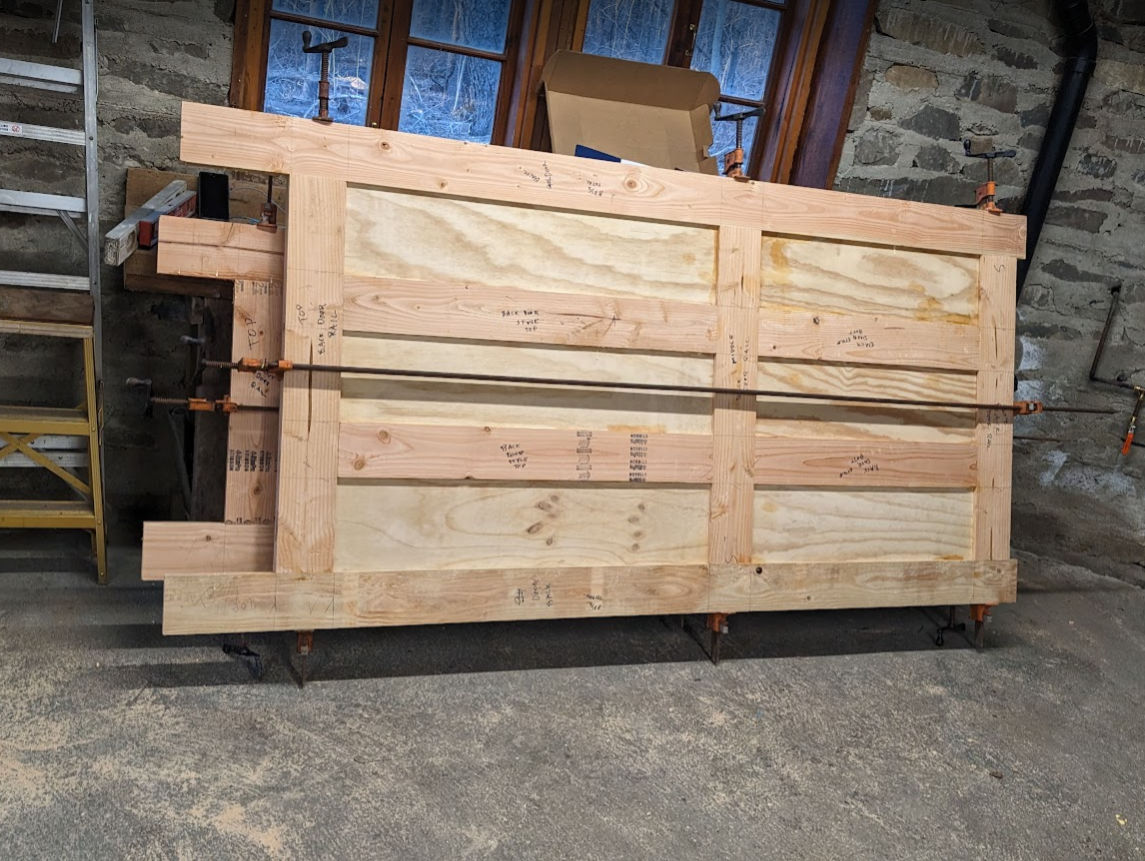
The mahogany double- and triple-hung windows Carter fabricated by hand in the basement workshop were milled using profile-ground shaper bits borrowed from Condon Lumber millwork in Greenhaven, New York — the same custom bits originally made to reproduce the A.J. Davis window profiles at Montgomery Place during restoration work there. Every window in Sneaker's Gap carries an identical profile to the 1863 Davis originals at Montgomery Place. As Carter wrote in his account of the window work: "There is no meaningful distinction between the craft as practiced then and as practiced here."The parallel to the great houses Carter was professionally responsible for maintaining is instructive. During the years of Sneaker's Gap's construction, Carter was living at Edgewater — Richard Hampton Jenrette's Greek Revival estate on the Hudson in Barrytown, four miles from the building site, one of the finest surviving examples of the tradition Carter was continuing. Montgomery Place, the Davis-designed estate in Annandale-on-Hudson that Carter's organization maintained, was built with the same fieldstone, the same lime mortars, the same constructional logic as Sneaker's Gap was being built with. When Carter led tours of the Davis outbuildings at Montgomery Place — as he did at the A.J. Davis bicentennial celebration documented in the July 2003 Times Herald-Record — he was describing buildings whose constructional secrets he had learned from the inside. Sneaker's Gap was the application of that learning to a new problem.7
The glamour of the visitor list requires a corrective. Carter was holding down two jobs simultaneously throughout the construction years — Director of Preservation and Physical Plant at Historic Hudson Valley by day, builder at Sneaker’s Gap on weekends and evenings. He was earning carpenter’s wages. There was no patron, no subsidy, no sugar daddy. The house was built on a working man’s income spread across years, at a time when raw materials could still be sourced directly — from the sawmill, the block factory, the machine shop, the welder down the road — without the markup of the hardware store.
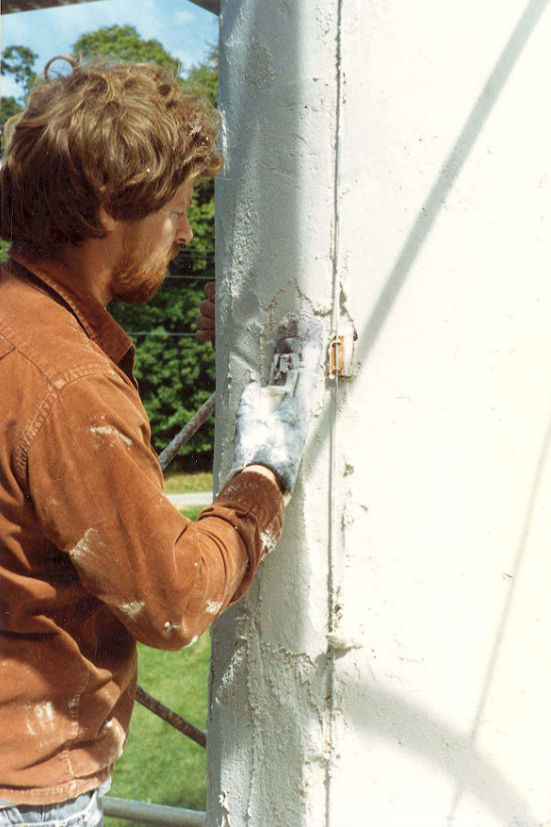
The white silica sand in the stucco on the Doric columns came, in part, from cigarette butts. When the Montgomery Place crew was applying the sand-painted finish to the exterior walls — blowing white silica sand with a modified sandblaster to simulate the texture of stone — Carter would pick the cigarette butts out of the discarded sand at the end of the day, collect them in spackle buckets, and bring them to Barrytown. The same sand that finished Montgomery Place finished the columns at Sneaker’s Gap.
His intellectual formation was wider than Benjamin alone. He had read Audel’s Carpentry and Building — the four-volume set from the 1920s — and referred to them throughout the construction years. He had been formed by years in Jenrette’s orbit, moving through Edgewater, the Roper House in Charleston, Milford Plantation in South Carolina, absorbing the classical tradition not as an academic exercise but as a lived environment. He had spent years at Montgomery Place with its A.J. Davis interiors. The 151 drawings are the record of a mind that had been marinating in classical architecture for a decade before it put pencil to paper. The Thomson inheritance ran underneath all of it — not as a conscious program but as something closer to instinct.
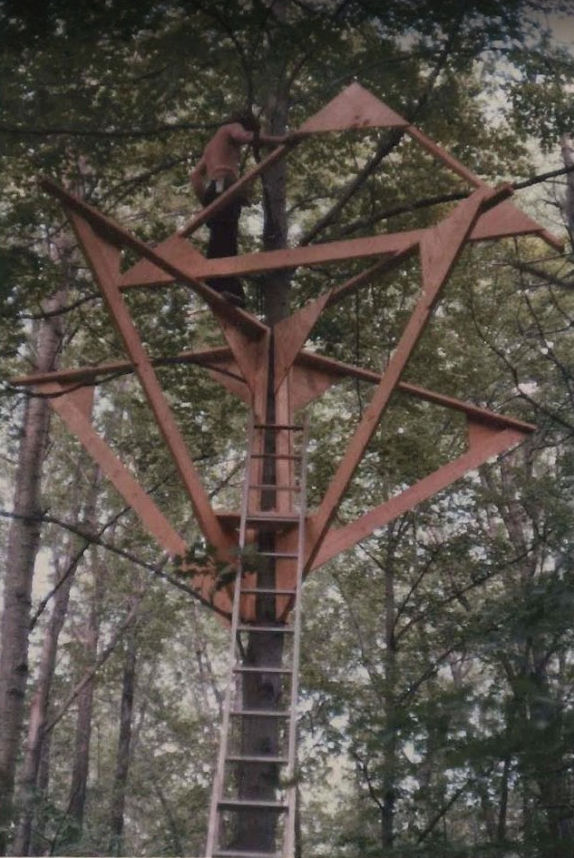
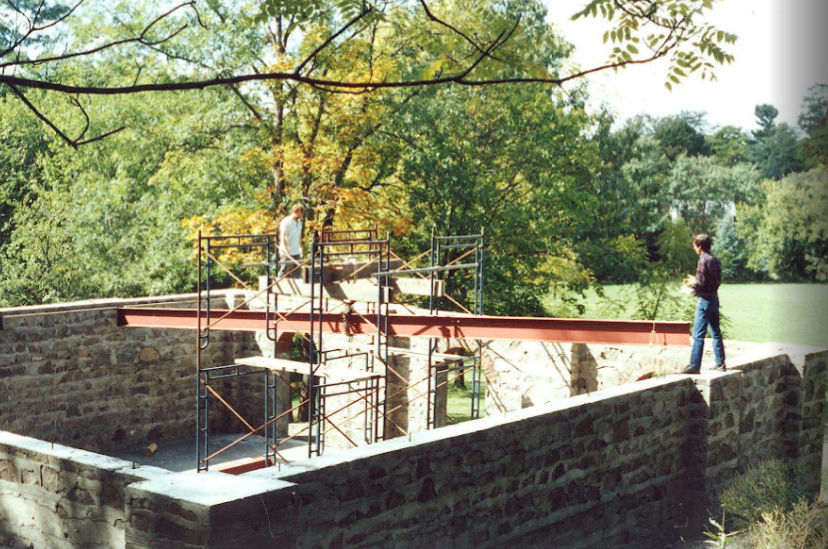
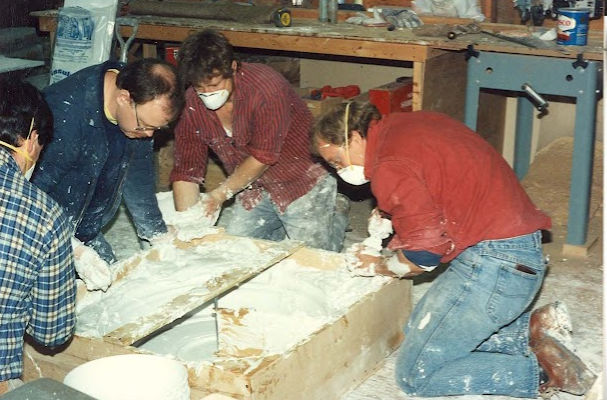
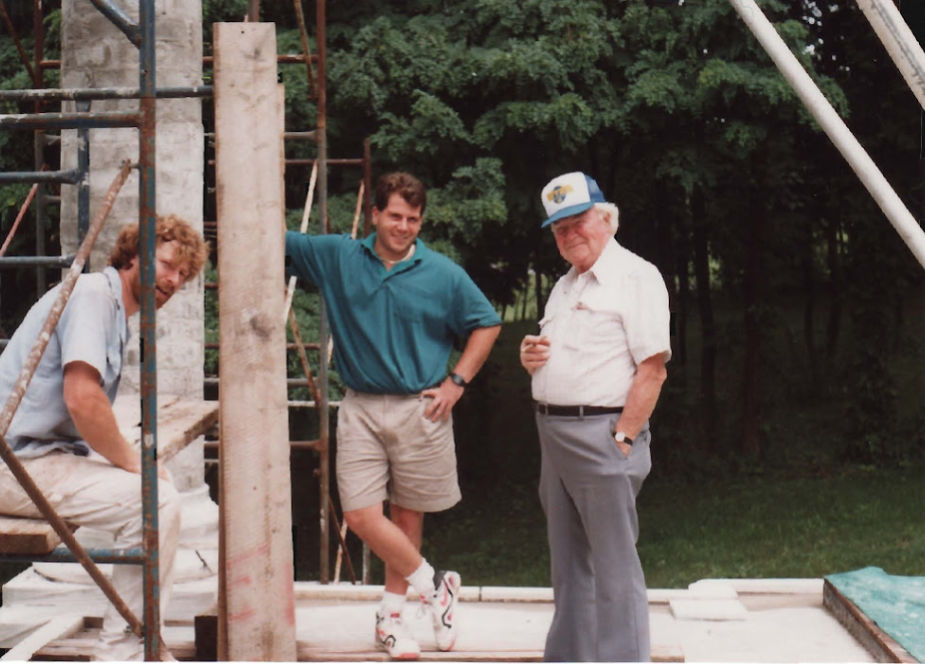
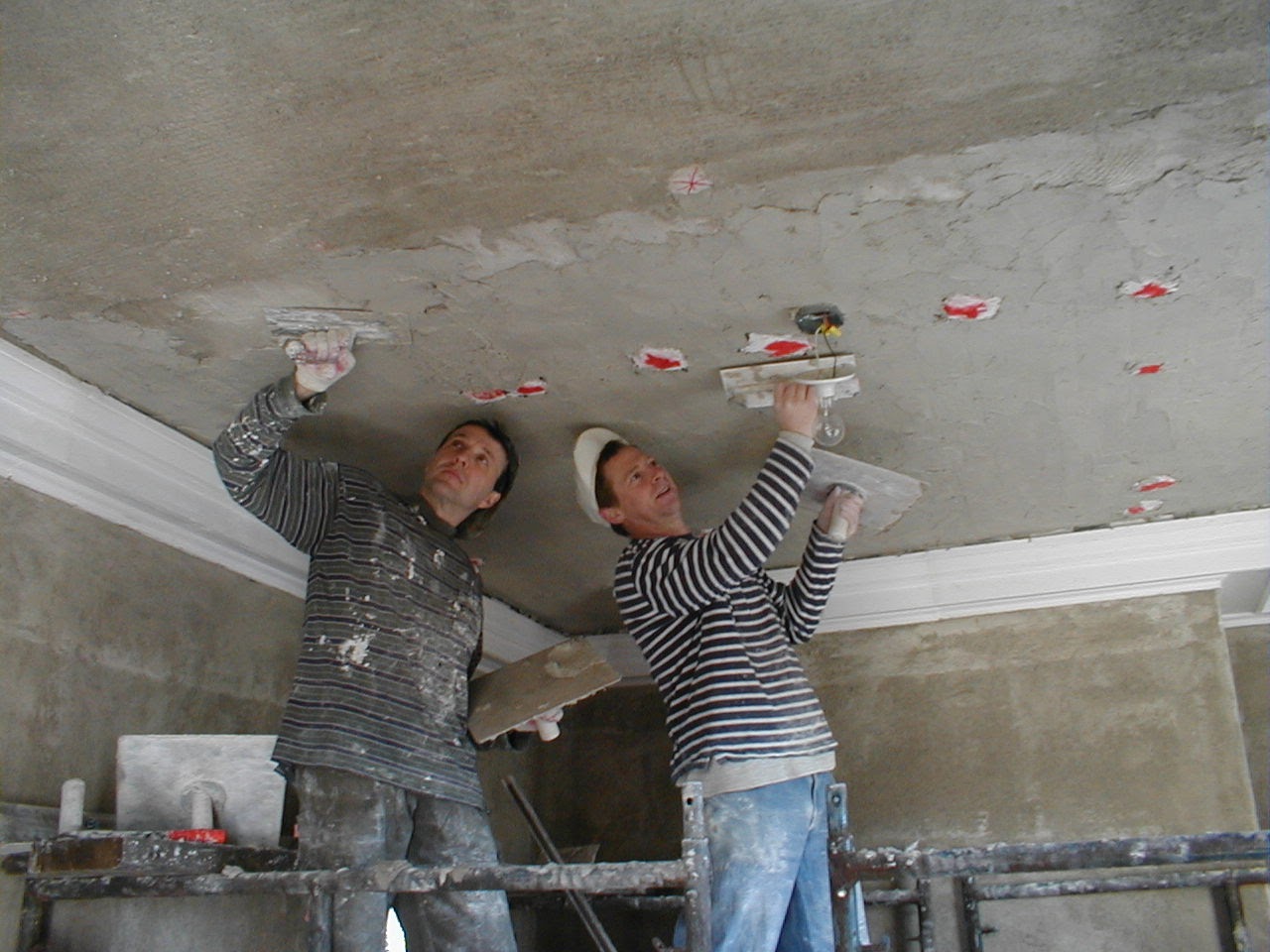
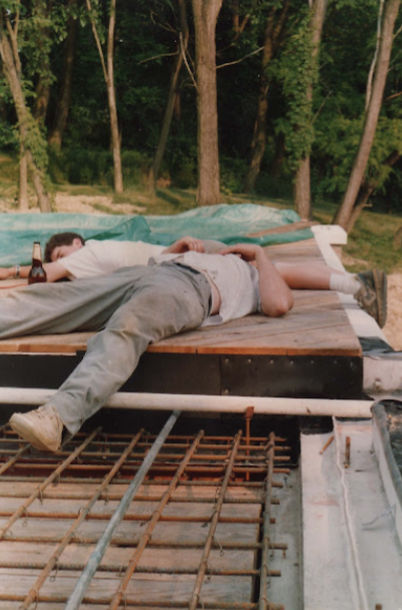
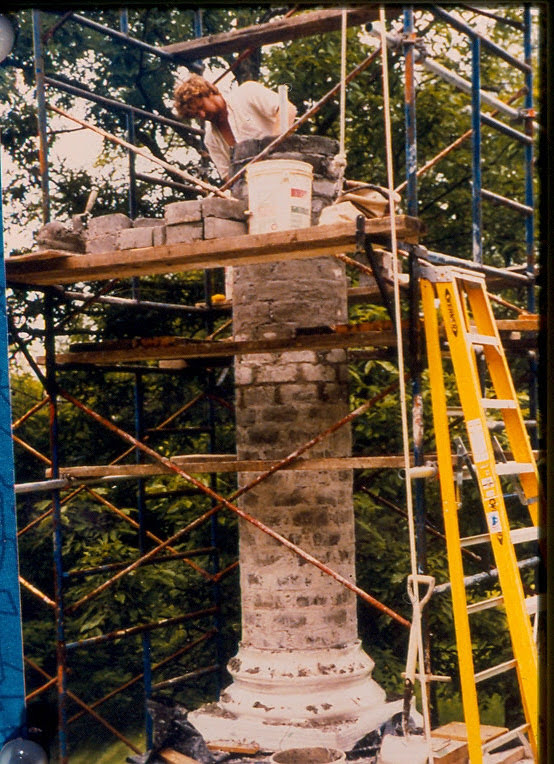
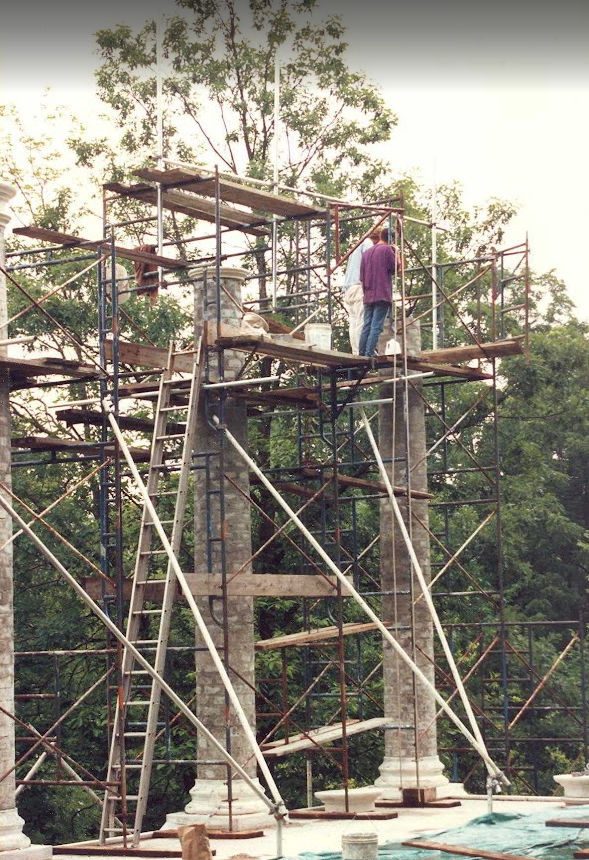
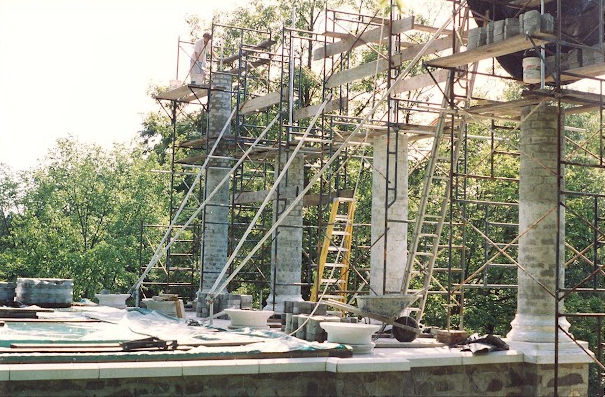
The people Carter was drinking with at night were not the dignitaries who signed the visitor log. They were the crew — the blood brothers, the friends who showed up on a Saturday because the work was interesting and because that was how things got done. It was a Tom Sawyer operation. Whoever came, worked. Tools were shared. Nobody asked about credentials. The scaffolding would have given OSHA a conniption — you can see it in the photographs — but nobody got seriously hurt. Except Carter. He made no distinction between who was who. He wasn’t impressed by the famous names and wasn’t trying to impress anyone. Brooke Astor wrote from Park Avenue; the crew showed up with their tools. Both things were true at the same time, and Carter moved between those worlds without ceremony, because the work was the same in both of them.
He went to Woodstock in 1969. He got by with a little help from his friends. The house got built the same way.
The Thomson Inheritance: Genealogy in Stone and Lime
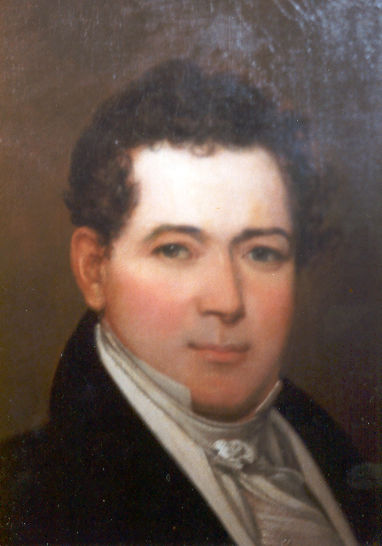
The genealogical dimension of Sneaker's Gap is not incidental. It is structural — both in the biographical sense and, almost literally, in the constructional one. Carter's great-great-great-grandfather Samuel Thomson (1784–1850) was one of the most productive and historically significant builder-architects working in New York City in the first half of the nineteenth century. Born in Baltimore and apprenticed as a carpenter, Thomson moved to New York in 1804 and became, by his death, one of the city's most respected builders. He worked alongside and in correspondence with the leading figures of the Greek Revival — Ithiel Town, John McComb Jr., and Minard Lafever — as a builder-executor of the first rank: a man who could realize at full scale what the architects of his era designed. He superintended construction of the U.S. Customs House on Wall Street — later Federal Hall National Memorial — appointed by President Andrew Jackson in 1833; the building was completed in 1842. He constructed Sailors' Snug Harbor on Staten Island from Lafever's designs, and built the Leake and Watts Orphan House from plans by Ithiel Town. He built Number 4 Washington Square North and is attributed with the entire north row. In 1835, Thomson purchased roughly 90 acres of the most rugged, elevated terrain in Northern Manhattan from the Dyckman family, christening the land "Mount Washington" — now the heart of Inwood Hill Park — and there built his own Greek Revival country house with a massive Doric-columned portico facing the Hudson.8
"There's a family history to this style. I had an attraction to it. It was almost a compulsion. I definitely believe in genetic memory."
— Geoffrey Carter, quoted in Martin Filler, "Greek Revival Inch by Inch," House & Garden, November 2002Carter became aware of this connection belatedly — a discovery, not an inheritance consciously pursued. William L. Hamilton, in his October 1995 New York Times Magazine profile, reports that Carter "made the belated acquaintance of his great-great-great-grandfather, Samuel Thomson, a prominent New York City designer and builder responsible for Sailor's Snug Harbor, the Federal Hall National Memorial and the north row of houses on Washington Square, through an etching of Thomson's estate that he found in his father's cellar." This etching — catalogued as Drawing 146 — depicts Mount Washington, Thomson's Greek Revival country house at the uppermost point of Manhattan Island, set into a wooded landscape above the Hudson. Carter almost certainly collected this print as a visual precedent before he knew whose house it was.
The discovery deepened with time. Carter learned that Thomson had been disinterred from the New York City Marble Cemetery and reburied in the Rhinebeck Cemetery — a few miles from where Sneaker's Gap now stands. Carter subsequently became the owner of Thomson's burial plot at the New York City Marble Cemetery, and holds the key to the vault where forty-two members of Thomson's direct lineage are interred.8a
The discovery reframed everything. What had begun as a personal project in classical construction became something more charged: a conscious resumption of a family tradition that had been interrupted for five generations. The proportional system Carter was using — Asher Benjamin's Roman Doric — was the same system Thomson had used. The constructional techniques Carter was teaching himself — lime mortar, rubble stone, hand-cast brick, sheet-metal cornice work — were the same techniques Thomson had mastered. Even the geographic setting was continuous: Thomson's country house had overlooked the Hudson from Manhattan; Carter's house overlooked the Hudson from Dutchess County. The river connected them.
The genealogical web proved denser still. In January 1992, J. Dennis Delafield — writing from 63 Wall Street, New York — replied to Carter's letter and article about the Leake & Watts Orphan Asylum with a revelation Carter had not anticipated. Delafield confirmed he had been on the Leake & Watts board for over twenty years, then added: "The coincidence is greater than you had imagined because while your third grandfather was the next door neighbor to Joseph Delafield in Riverdale in 1832, his neighbor on the other side I see is a William C. Wetmore and Granny Delafield of Montgomery Place was descended from the Wetmores. In fact, you will find their coat of arms and a portrait of General Wetmore in the house." The building Carter was professionally responsible for maintaining — Montgomery Place, Barrytown — contained the portrait and coat of arms of the family that had been his own grandfather's neighbor in Riverdale in 1832. Carter had been working, every day, in a house that his family had lived adjacent to 160 years before.
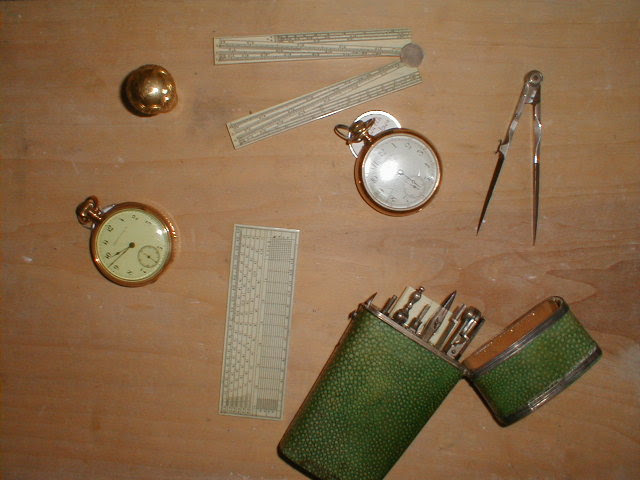
The material connection goes deeper than genealogy. Carter had inherited several of Samuel Thomson's actual tools.
The House & Garden piece documents "a few of Samuel Thomson's tools, some of which he inherited, such as an ivory and silver drafting set; others he found in a nearby ancestral barn, such as several period molding planes, whose handles bear the burned-in initials 'S.T.'" Carter was using these planes on Sneaker's Gap. The molding profiles they cut are functionally identical to the profiles Carter had specified in his drawings, derived from Benjamin's system: the cyma recta, the ovolo, the fascia, the taenia. The same iron that had cut moldings for Federal Hall in 1840 was cutting moldings for a house in Barrytown 150 years later. This is not metaphorical continuity. It is material continuity in the most literal sense.
The genealogical connection extended to a specific material object. Through his research on Thomson, Carter learned of a marble mantle from Italy — with beautifully carved ornament — that had been installed by Thomson in 1831 at Number 11 Washington Square North. When the house was gutted in the 1930s, the mantle passed eventually to Howland Davis of Tivoli, New York, whose grandmother had lived there. Carter purchased it from Davis and plans to install it in the parlor of Sneaker's Gap — the mantle Thomson placed in 1831 finding its final home in the house his descendant built 160 years later.
Carter published his research on Thomson in the Preservation League of New York State Newsletter (Fall 1991), identifying himself as "Director of Preservation for Historic Hudson Valley in Tarrytown and a descendant of Samuel Thomson." The scholarly reception had already been confirmed in September 1989, when David Bahlman, Executive Director of the Society of Architectural Historians, wrote to Carter with a handwritten postscript: "The information on Samuel Thomson is indeed exciting — I think submission to the JSAH is a wonderful idea." The executive director of the field's leading scholarly organization was personally encouraging Carter to submit his Thomson findings to the Journal of the Society of Architectural Historians at the very moment the foundation walls at Barrytown were going up. The following year, Jane C. Nylander, Director of the Society for the Preservation of New England Antiquities, wrote to Carter after he presented the Montgomery Place restoration to an SPNEA tour group, noting that members had been fascinated by the work and that it offered solutions to problems they faced at their own properties. SPNEA, based at the Harrison Gray Otis House in Boston, was among the most serious preservation organizations in the country.
The research extended to fieldwork. Among the documents Carter discovered in the Westchester County Archives was a large cloth map showing Thomson's landholdings near Spuyten Duyvil — the northernmost tip of Manhattan — with a lime kiln marked on the shore bank, adjacent to Thomson's wharf. Lime kilns were essential to the Greek Revival builder: the slaked lime was mixed into the stucco that finished the columns, the plaster that finished the walls, the mortar that laid the brick. Thomson, it turned out, had operated his own supply. Carter decided to find it. Playing hooky from work one afternoon, he drove to Inwood with a companion and parked under the Henry Hudson Bridge. An old man in the adjacent parking space struck up a conversation, said he knew where the kiln was, and offered to lead them. They hoofed north along the railroad, hugging the third rail. "Look right," the man said. And there it was — an unnatural hump in the ground, surrounded by a collar of oyster shells, the calcined residue of two centuries of burning. Carter climbed all over it. Since then, he has ridden the coach to New York City on the land-side row of the train, watching for the hump through the blur of the window. The kiln is there, cold, no smoke from the chimney. But he knows where it is.
The working drawing sheets document Thomson's presence in Carter's design process in a still more oblique way. Drawing 76 is a notes sheet with a printed portrait etching pinned or taped to the lower right — identified as Samuel Thomson, possibly the Brady photograph. The handwritten note reads: "Entab set back 2.215" from column face or foundation face." Thomson, or his image, was present at the drafting table as Carter worked out the critical setback dimension for the entablature. Whether this was deliberate invocation or unconscious talismanic presence, the archive records it: the ancestor looking over the shoulder of the descendant as the drawing was made.
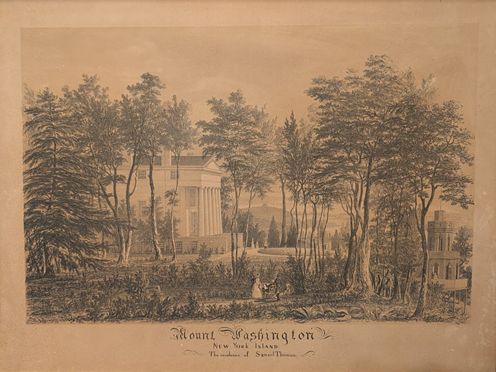
Printed engraving found among Carter's drawings. Caption: "Mount Washington / New York Island / The residence of Samuel Thomson." Depicts a large Greek Revival house with full Doric colonnade visible through a wooded landscape. Carter almost certainly collected this print as a visual precedent for his Barrytown house before he knew that Thomson was his direct ancestor.
When the bulldozer cleared Carter's land at the beginning of construction, it turned up remnants of a house that had once stood on the same site — fragments dated by a museum curator colleague to between 1790 and 1820, roughly the stylistic period of the house Carter was building. A clay pipe stem. A piece of porcelain painted with an Ionic column. A pewter spoon. Handmade nails. Oyster shells. These fragments were not merely charming coincidences. They were evidence of the same local building culture that had produced Thomson's buildings, that Benjamin's book had served, that Carter was resuming. The ground itself had a prior history in the tradition.
The Drawing Archive: 151 Documents of a Mind at Work
The Carter Drawing Catalog — 151 drawings and documents produced between September 1987 and July 1994 — is an archive of unusual completeness and historical significance. No comparable primary source exists for any other self-built classical house in America. The archive encompasses regulatory approvals, survey maps, design studies, construction documents, structural engineering, field instruction sheets, a commissioned perspective rendering, and a sheet of what can only be described as frustration doodles. Together these documents constitute a record not merely of what was built, but of how it was thought through — the intellectual process by which a self-taught builder, working evenings and weekends over the course of a decade, produced a resolved classical composition of genuine architectural quality.
The chronological structure of the archive is itself instructive. The earliest dated document is the Dutchess County Department of Health signatory page (Drawing 37), signed by Carter on September 12, 1987, and approved by the county on October 29, 1987. Carter had secured site approval for sewage disposal and water supply before producing a single architectural drawing — following the same logic that governed nineteenth-century rural building practice, in which the viability of a site for habitation had to be established before the character of the habitation could be determined. The formal drawing set was opened only when the site was understood and the proportional system was in hand.
Carter purchases 2.250 acres on County Highway 82, Town of Red Hook, from Robert E. and Margaret Smith. Purchase recorded December 18, 1986, Liber 1729, page 610. The deed covenant prohibits prefabricated structures on the premises — a legal condition coinciding exactly with Carter's own convictions about construction.
Owner signs Dutchess County Department of Health application for well and sewage disposal. Site approval granted October 29, 1987. The earliest document in the drawing archive. (Drawing 37)
Earliest architectural drawing: large-scale cornice and column base study at 3/4"=1', titled "Emasculated Details." Carter is studying the orders before opening the drawing set. (Drawing 130)
West Elevation title block EL-W opened. The formal beginning of the architectural drawing set. (Drawing 57)
East Elevation and Second Floor Plan title blocks opened in rapid succession. Carter is developing all aspects of the composition simultaneously. (Drawings 58, 68)
Full construction document set produced: North, South, East, and West Elevations; First and Second Floor Plans; Basement Plan; North-South Section; East-West Section; Structural Cross Section. Multiple sheets receive professional engineer's stamp. (Drawings 66, 121, 131)
Sheila McGowan produces perspective rendering from Carter's drawings, signed 1989 — pre-Falatko. (Drawing 91). Slip-form wall construction documents produced and updated through July 1990.
Stephen Falatko writes to Carter offering professional collaboration, having visited Sneaker's Gap and read Carter's published articles on Thomson and Leake-Watts. Carter's marginal annotation on the letter: "fantastique!"
Falatko partnership documents: Section drawing (May 3), Northeast Elevation (May 7), Sitting Room Elevations (June 21), Stair Hall Elevations (June 21). (Drawings 145, 149, 143, 151)
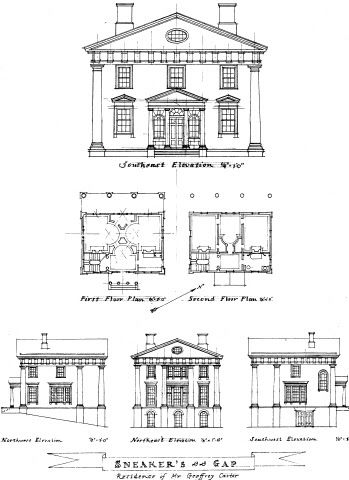
Formal partnership presentation sheet: "Sneaker's Gap / Residence of Mr. Geoffrey Carter / Barrytown, NY." Three elevations. G.B. Carter & Stephen Falatko AIA Architects credited. The latest dated drawing in the architectural design set. (Drawing 136)
The design studies within the archive document a process of systematic refinement rather than radical revision. The five-column west façade scheme — pursued through at least five separate drawings before being formally withdrawn with the annotation "Superseded" in pink ink (Drawing 34) — is the most significant design decision documented in the archive. The drawn record of this decision — multiple sheets showing the rejected alternative, one formally marked as superseded — is the kind of documentation that architectural historians rarely encounter for buildings of any period. The final four-column arrangement was confirmed in consultation with Richard Crowley, architect and co-founder of Hudson River Heritage, who advised Carter after both the five-column scheme and an uneven four-column arrangement had been rejected.9

West Elevation, three-story composition. Pediment with elliptical oculus and sunburst. Five Doric columns. Three arched basement openings. Annotation in pink ink: "Superseded." Formally withdrawn from the drawing set. The pink ink annotation is unique in the archive — Carter's own formal notation marking a design decision of fundamental consequence for the final composition.
The Falatko partnership phase — initiated in early February 1993 and producing its final dated document on July 29, 1994 (Drawing 136) — represents the most complex chapter in the drawing archive.
Stephen Falatko, AIA, was an architect working in Dutchess County whose previous affiliations had included the offices of Robert A.M. Stern, Harry Weese, and Scofidio and Diller, and who had received the New York State AIA's highest Award for Design Excellence. He had a Princeton Masters of Architecture (1982). As Patricia Leigh Brown described him in her 1995 New York Times feature, he was working on "a reinterpretation of the spare, elegant Greek Revival houses and farm buildings of the Hudson Valley." The partnership began when Falatko visited Sneaker's Gap and wrote to Carter days later — on February 3, 1993 — offering to lend "some professional advice when it comes to planning and detailing the building as it progresses — all in the good cause of a fellow classicist's." He had already read Carter's published articles on the Leake-Watts Orphans Asylum and Samuel Thomson, which he described as "immensely suggestive." Carter's contact list confirms that Thomas Gordon Smith — Dean of Notre Dame's architecture school, and the figure whose epigraph opens this essay — had also visited Sneaker's Gap with Falatko, making the house, in its half-built state, a site of pilgrimage for the classical revival's leading academic figures.

Falatko's annotations on Carter's drawings deserve particular attention. On the foundation wall section (Drawing 28), Falatko's red ink notes read: "Insulation needed in walls," "Missing sill seal and termite shield," "Missing wall insulation and floor insulation," followed by the summary judgment "Shows lots of work. A–." The grade is perhaps the most remarkable annotation in the entire archive: a licensed architect assessing a self-taught builder's structural section drawing, finding it technically deficient in the practical requirements of contemporary construction but substantively competent as a classical composition. On the cornice details (Drawings 29, 30): "Did you copy this?" — meaning, from Benjamin, which Carter had.
Large-scale section through foundation wall, first floor, and column base. Slip-form fieldstone and rubble wall 16" thick. 3500 PSI concrete floor. 36"×14" concrete footing. Step footing to 42" below grade. Red-ink annotations by Stephen Falatko: "Insulation needed in walls," "Missing sill seal and termite shield," "Missing wall insulation and floor insulation." Summary assessment: "Shows lots of work. A–." The grade is the most historically remarkable annotation in the archive.
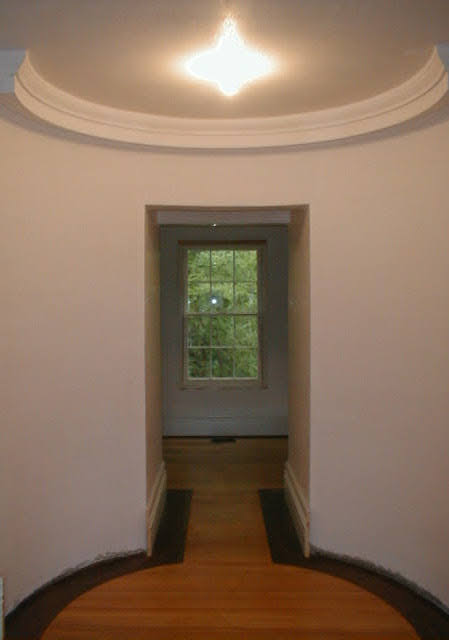
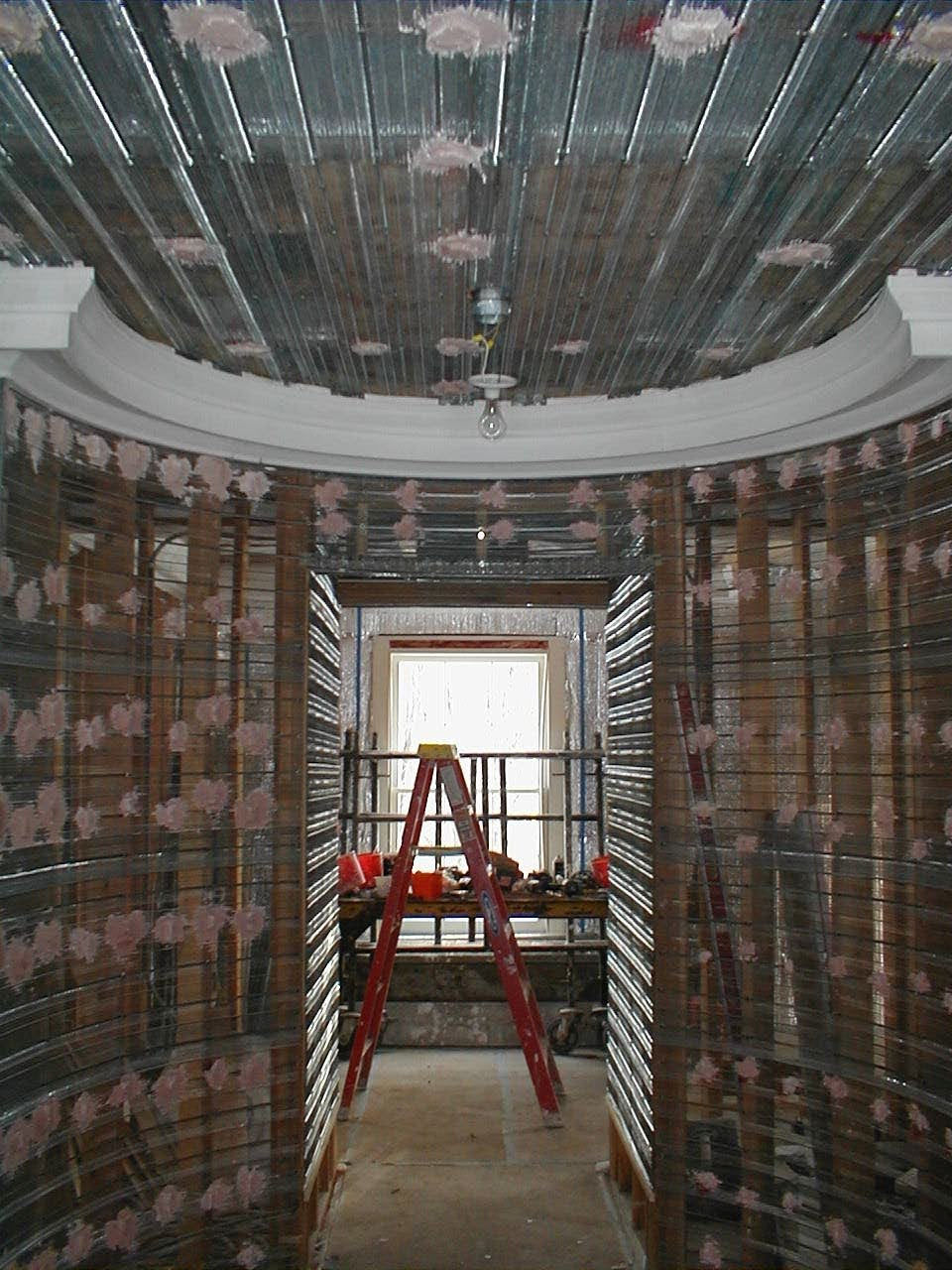
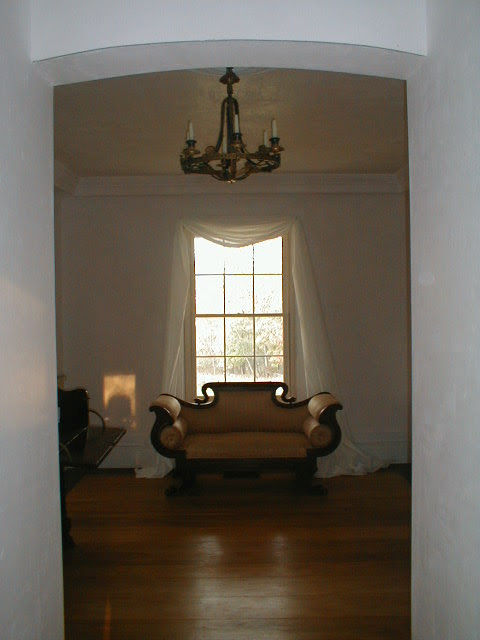
The formal partnership presentation sheet of July 29, 1994 (Drawing 136) shows the house at a scale and level of elaboration that goes substantially beyond what Carter had drawn independently — a full colonnade on multiple facades, an octagonal entry element, a more elaborate composition with arched sidelights and decorative finials. This was Falatko's vision of what the house might become. It is a beautiful set of drawings. But it was not built. The house that emerged from the ground is closer to Carter's original 1989 construction documents. The Falatko influence that persisted — the curving interior walls he introduced into the floor plans, the revised cornice profile replacing Carter's cyma recta with a Howard cornice (Drawing 137) — was refinement, not reconception. The problem Falatko was solving — how to introduce curved interior volumes into a rectangular classical scheme without destroying the external composition — was the same problem Jefferson had worked out in pencil on the Rotunda floor plan at UVA, adding curved walls after discovering that acute angles made awkward spaces. Carter had seen those drawings on his September 1988 visit, five years before Falatko proposed the same solution at Sneaker's Gap.

The archive also preserves two documents that might be considered the most humanly significant in the set. Drawing 74 is a title block with no drawing number or project title filled in — a document of interrupted work, of a project that paused for a period while life continued. And Drawing 147 — catalogued simply as "Frustration Doodles" — is a blank drawing sheet with energetic pencil scribbles in the lower center: looping, circular, scratching marks. No notation identifies who made them or when. They are evidence of the psychological texture of a decade-long construction project. Every building that has ever been built has had such moments. The Carter archive preserves one of them. Carter's own account adds two others: in 1988, during land clearing, a backhoe went out of control, struck a tree, and threw him thirty feet onto his head in the swamp, knocking him unconscious; in 1992, while applying stucco to the columns, he burned the corneas of both eyes and could not see for nearly a week while they healed. His own formulation is blunt: "It is the nature of building to overcome adversity. There is a punishment inflicted on the men who elect to build."
The Classical Revival and Its Limits: Design Without Construction
The intellectual context within which Sneaker's Gap must be situated is the classical revival that emerged, haltingly but with increasing institutional confidence, in American architecture during the 1980s and 1990s. The movement had several distinct streams. At Notre Dame, Thomas Gordon Smith and Michael Lykoudis were transforming the architecture school's curriculum to restore classical training as the foundation of architectural education. In New York, the Institute for Classical Architecture (later the Institute of Classical Architecture and Art, which organized the 2009 Hudson Valley excursion) was founded by Donald Rattner and Richard Wilson Cameron. In practice, firms like Ferguson Murray & Shamamian and individual architects like Michael Dwyer, Richard Franklin Sammons, Anne Fairfax, and Stephen Falatko were producing classical buildings of genuine quality.10
"He has done it much more convincingly than many of the best-known names in the present-day classical revival movement."
— Martin Filler, "Greek Revival Inch by Inch," House & Garden, November 2002The February 1995 New York Times feature — "Architecture's Young Old Fogies," by Patricia Leigh Brown — captured this moment with intelligence and some sympathy. The piece documented several of the movement's key figures: Sammons, Dwyer (who had completed an $8.95 million East Side town house and was renovating Nureyev's Dakota apartment "à la grecque"), Rattner, Cameron, Falatko (described as working in Dutchess County on a "reinterpretation of the spare, elegant Greek Revival houses and farm buildings of the Hudson Valley"). And it included Geoffrey Carter, described as having spent "the last five and a half years creating his own $150,000 heavenly mansion, a temple-like house which he has built brick by handmade brick — all 1,800 of them." The contrast in scale and cost between Carter's project and its neighbors in the article is striking. Sammons was designing a 15,000-to-20,000-square-foot mansion in Nashville inspired by Palladio and Jefferson. Carter was building a 4,500-square-foot house in Dutchess County using Dixie cups to cast his ornaments. Thomas Gordon Smith, whose epigraph opens this essay, had by this point visited the house in person with Falatko — a detail that Carter's contact list records with characteristic brevity: "Was in NYTimes Article — Visited House with Steve."
The House & Garden feature of November 2002, by critic Martin Filler, made the evaluative judgment most explicitly. Carter, Filler wrote, had "done it much more convincingly than many of the best-known names in the present-day classical revival movement" — not because he was a more gifted designer, but because his commitment was deeper. "Rather than saving another old house, he has been using his nights and weekends to build a new one, in which he's trying to restore the principles and techniques of classical architecture as it was practiced in the United States two centuries ago." The distinction matters. To restore principles and techniques is a different ambition from designing classical buildings. It is the difference between speaking a language and teaching it — between fluency and grammar.
Carter had articulated the central problem himself, in his own terms, in unpublished writings produced during the construction years: "A division occurred in the early 19th century, a maturity some would say. Not unlike being sexed at birth. The mind was separated from arms. To this day, builders and architects struggle to reestablish synchronization." The essay's central argument is contained in those three sentences.
The theoretical distinction that Carter's project illuminates — and that the academic classical revival of the 1990s largely failed to address — is the distinction between classical design and classical construction. Classical design, as practiced by the movement's academic and professional wing, involved the correct application of the orders to contemporary building programs: the right proportions, the right ornament, the right relationship of part to whole. It was a visual and intellectual discipline, and it produced buildings of genuine quality. But it operated within the constructional framework of contemporary practice — steel structure, synthetic insulation, mass-produced millwork, prefabricated windows. The classical vocabulary was applied to a building whose bones were indistinguishable from those of any other contemporary construction.
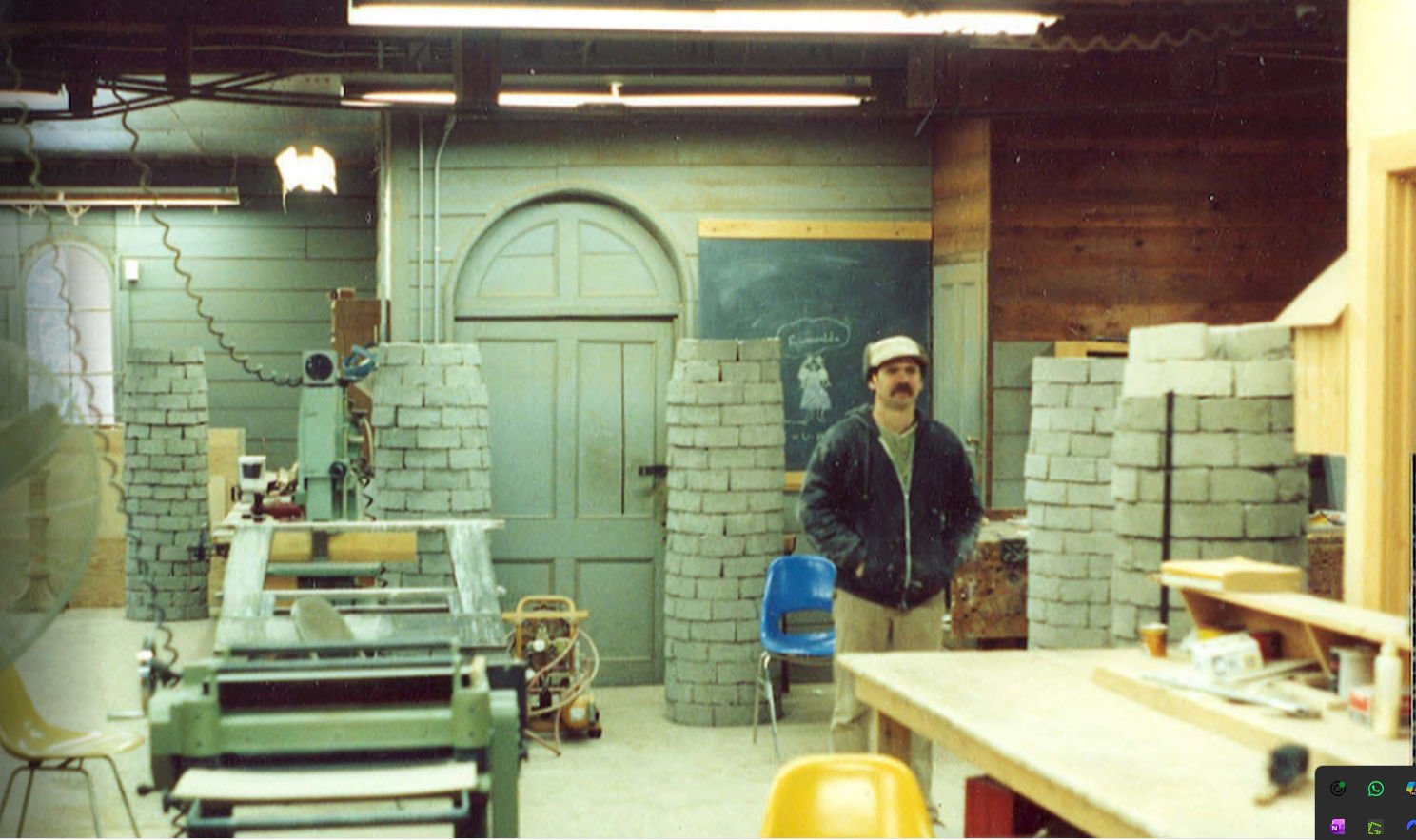
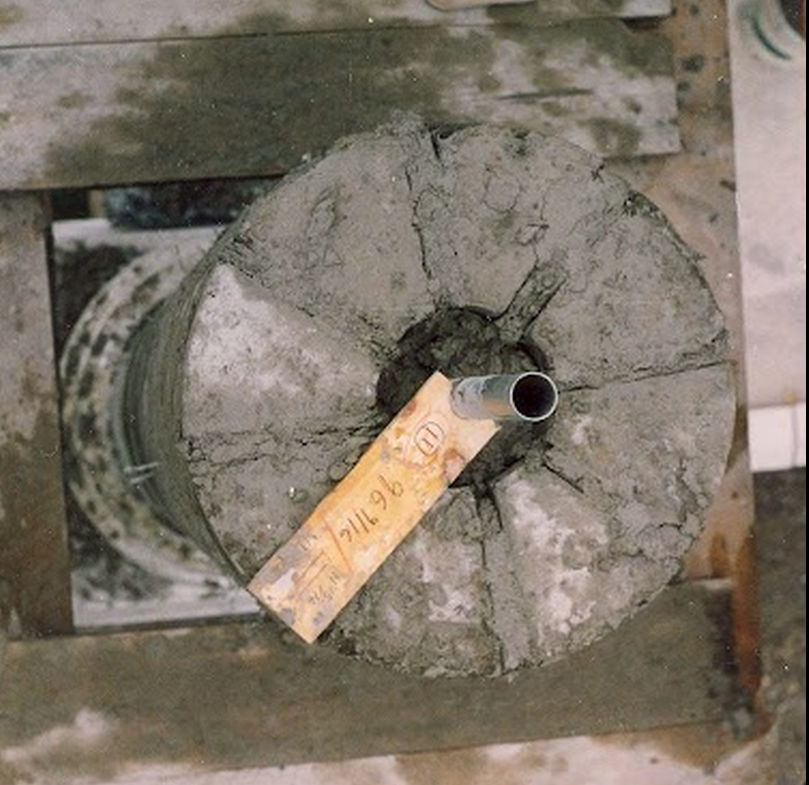
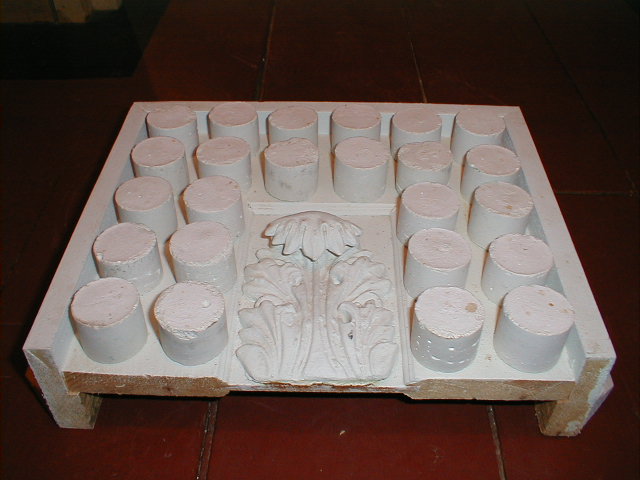
Classical construction, as Carter was practicing it, involved something different and more radical: the restoration of the physical processes by which the original buildings were made. No synthetic materials. No prefabricated elements. No Home Depot solutions to a twenty-foot Doric column problem. The columns at Sneaker's Gap are built up from 1,800 circular concrete bricks, cast by Carter in spring-form frames resembling cake pans, laid in courses with mortar joints calibrated by a wooden stick to achieve the correct entasis — the slight taper from bottom to top that prevents the optical illusion of outward flare. The resulting texture, as Filler noted in House & Garden, has "the pleasing texture of the real thing, rather than the too-perfect finish of machine-made modern copies." The governing table — derived from Benjamin's diminution formula — records the column shaft moving from a base radius of 12⅛ inches at ground level to 101⁄16 inches at the neck, in thirty increments over a shaft height of 21211⁄16 inches. This is not approximation. It is calculation executed in masonry at the scale of a sixteenth of an inch per course.
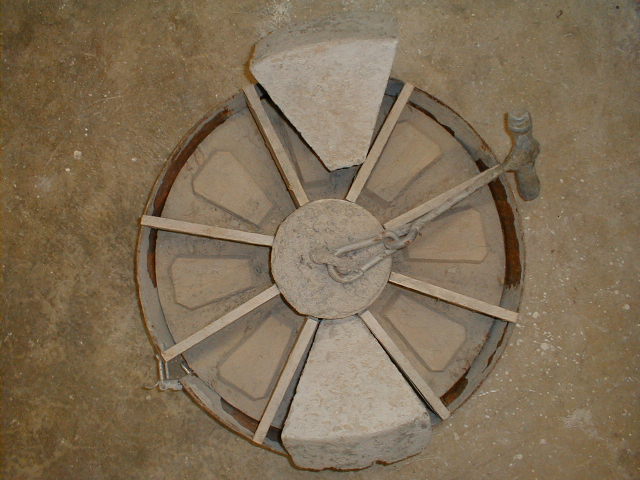

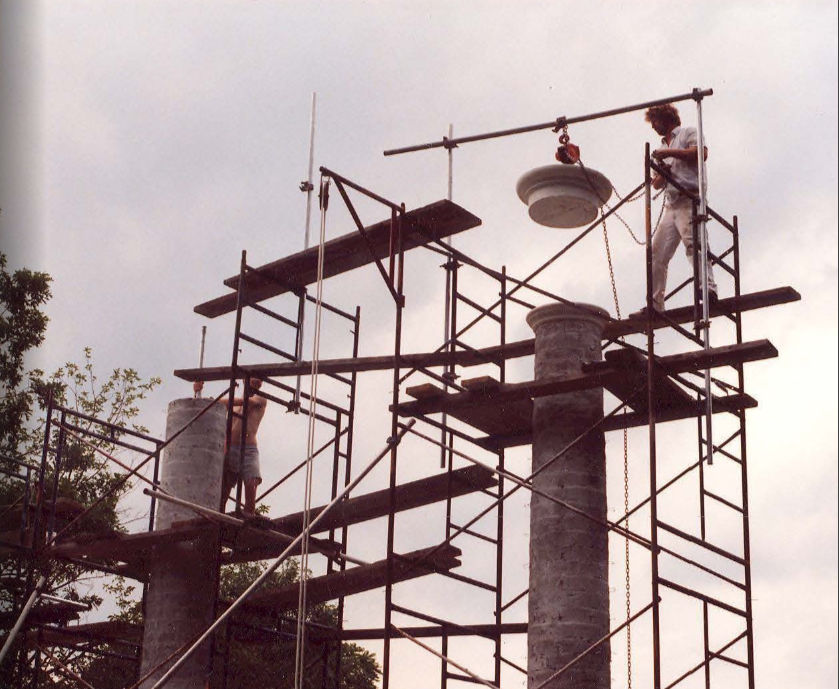
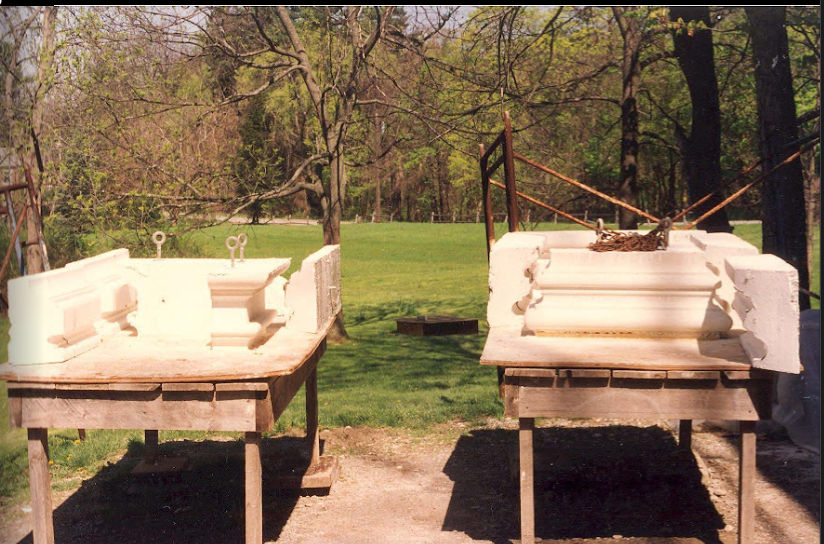
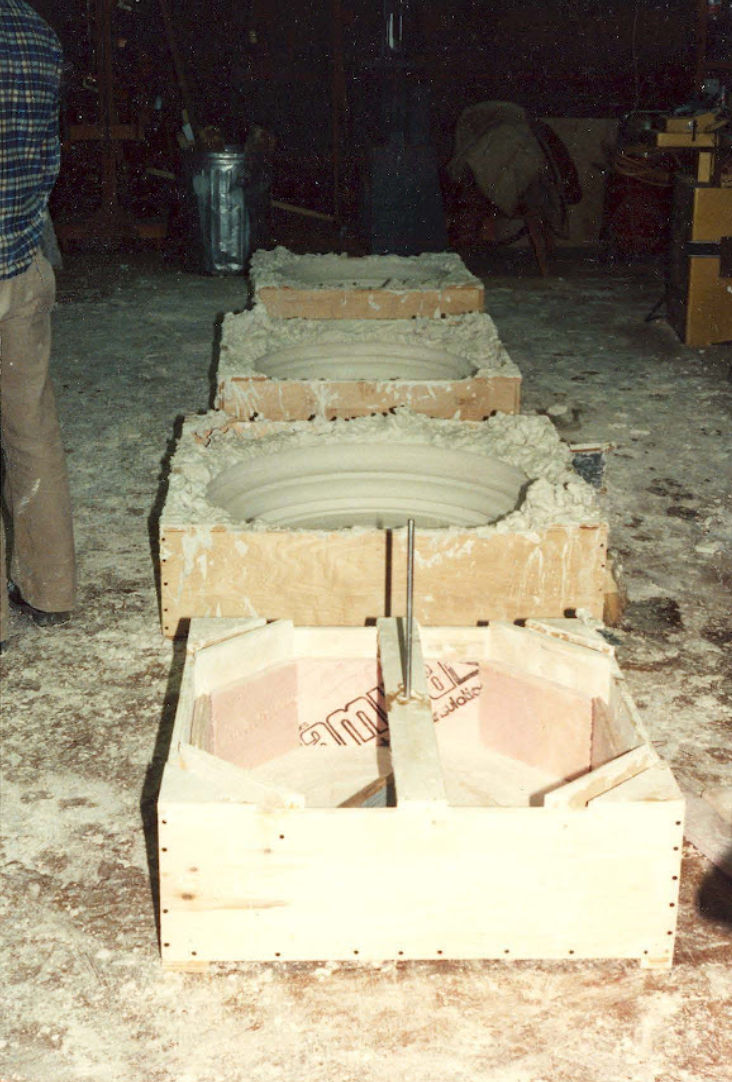

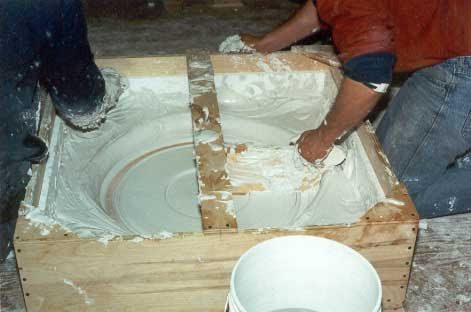
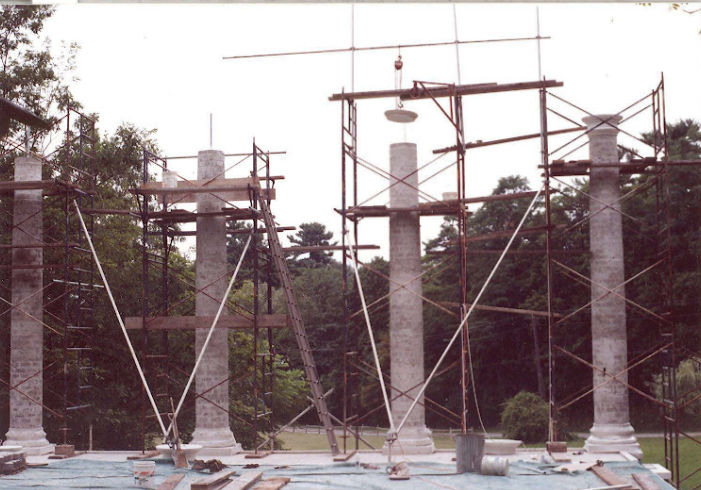
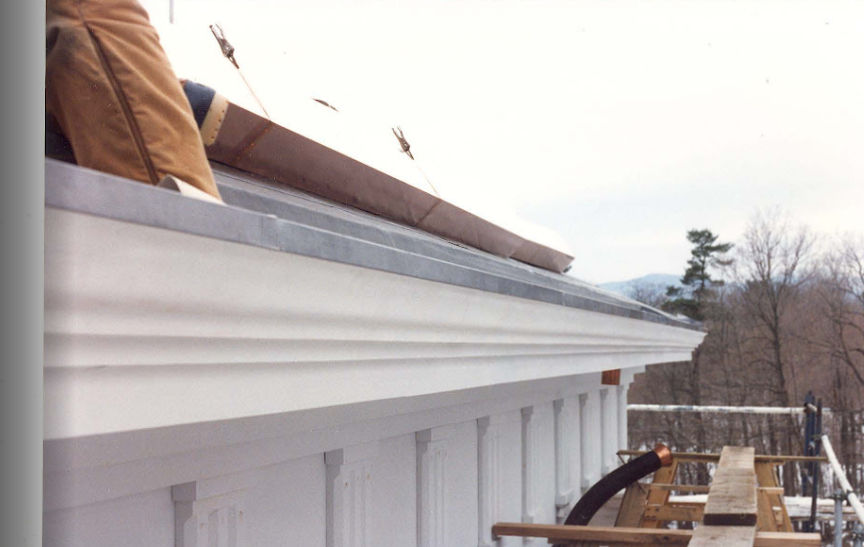
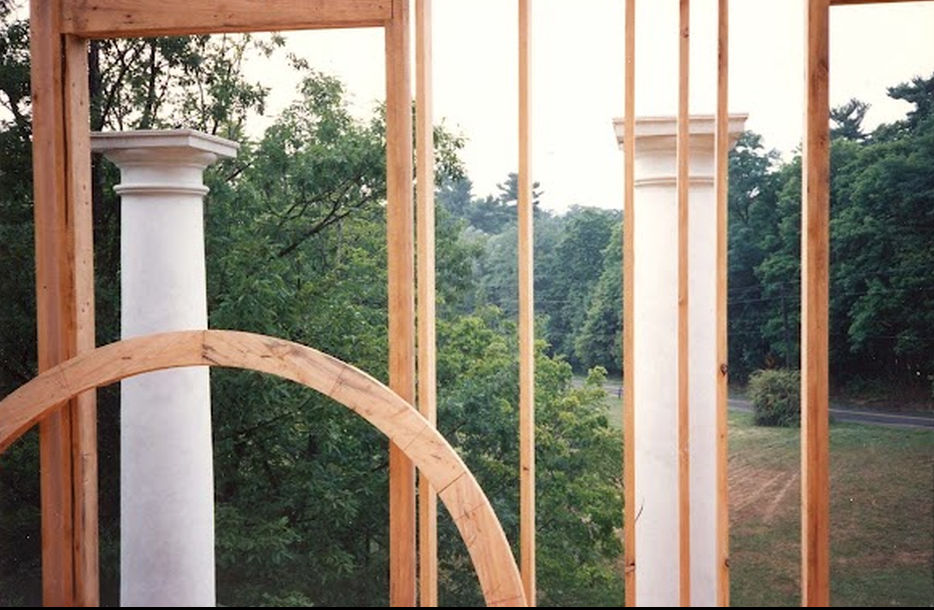
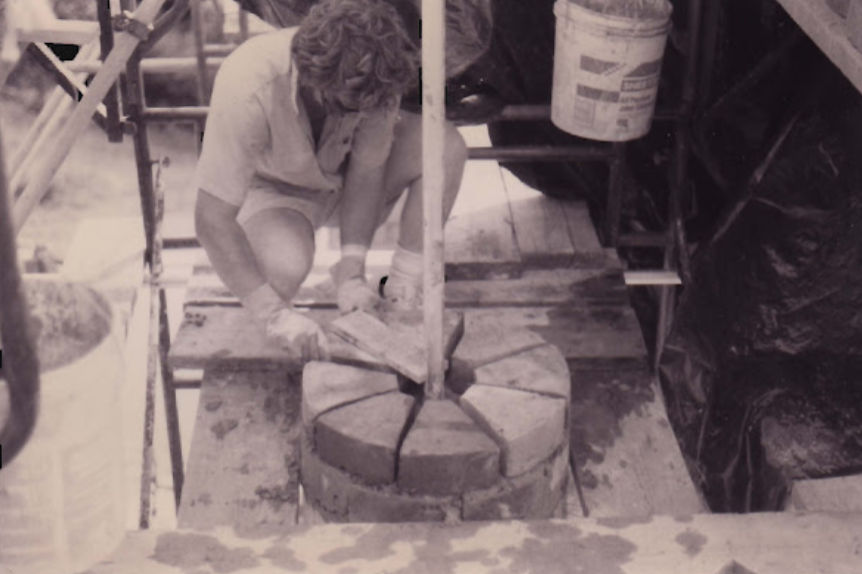
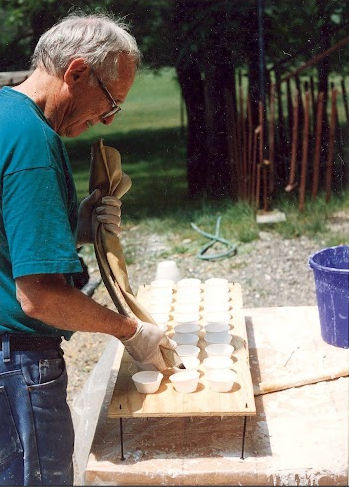
The 312 conelike ornaments that punctuate the columns — the guttae of the Doric order, suspended below the triglyphs and regula — were cast in Dixie cups from white cement. Each one is slightly different from every other one, as each hand-mixed batch of concrete produced a slightly different result. The triglyphs themselves — the sixty-three blocks that Carter and his helpers were sanding on the lawn in the autumn of 1995 — had been hand-shaped and hand-finished.
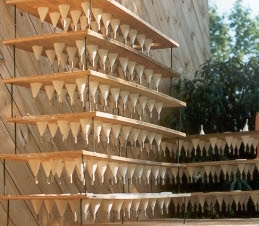
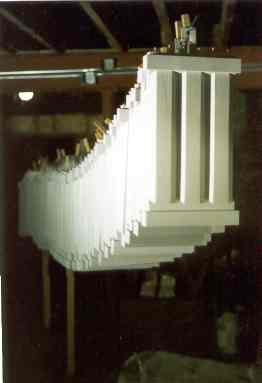
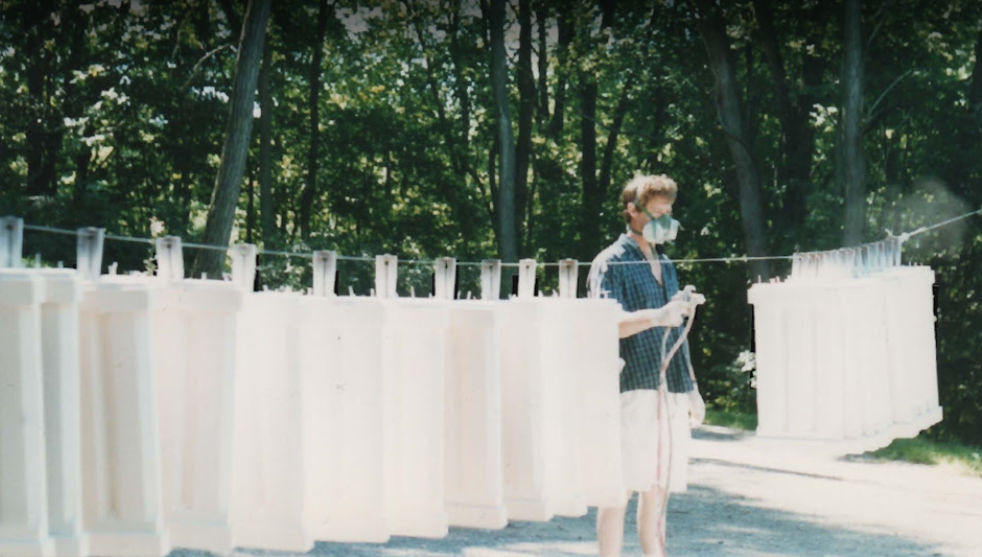
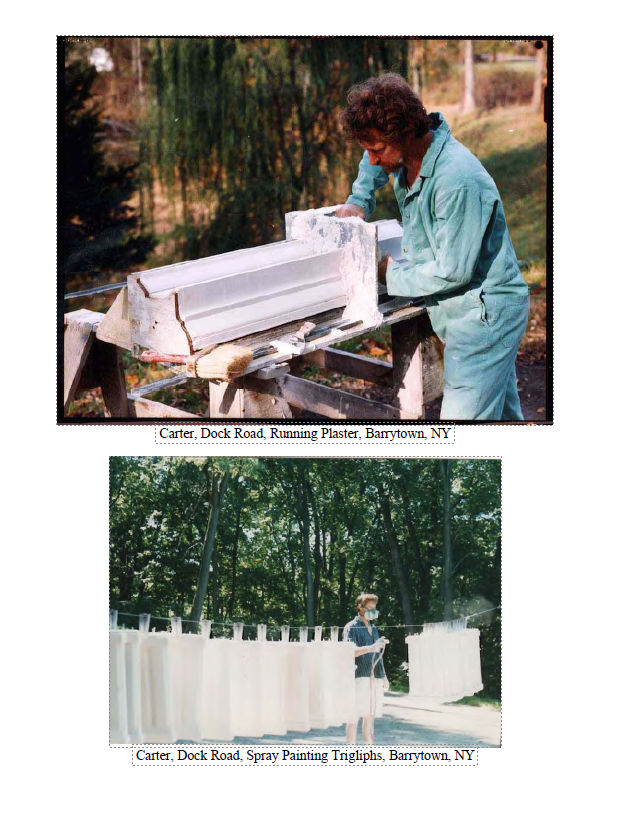
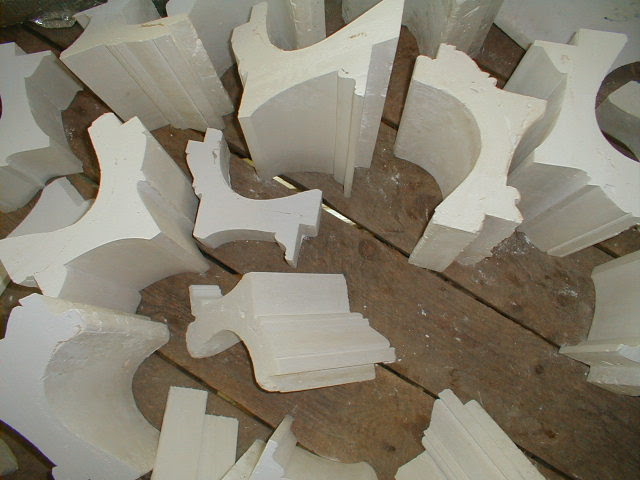


The elliptical oculus in the pediment (Drawing 78: the only drawing in the set dedicated solely to the geometric layout of the sunburst glazing pattern) was laid out by Carter with compasses and straight edges, twenty-four radiating muntins extending from the central oculus to the outer ellipse, before any glass was cut. Every element of the building has a history of making — a record of the specific physical operations by which it was brought into existence. This is what classical construction means, and it is what the academic classical revival, however meritorious its design achievements, did not and could not provide.
Full-size or large-scale layout drawing of the elliptical oculus glazing pattern for the pediment. Outer ellipse, inner ellipse, and central small ellipse drawn in blue ink. Twenty-four radiating muntins extending from the central oculus to the outer ring, creating the sunburst pattern visible in the finished pediment elevations. The only drawing in the set dedicated solely to the geometric layout of this signature decorative element.
This argument requires one qualification. Carter was not a purist in a doctrinaire sense, and the drawing archive documents several practical accommodations to contemporary reality. The roof is a raised-seam terne metal roof (Drawing 19), a traditional material but one manufactured industrially. The structural steel chimney support beams (Drawing 102), fabricated at Millenn Steel in Kingston from W10x39 I-beams, are entirely contemporary. These accommodations do not undermine the project's integrity; they define its limits honestly. Carter was not attempting a museum-quality reconstruction of a specific historical building. He was attempting, as Bolender put it, to use construction techniques and materials that were "appropriate" to the tradition he was working within — techniques and materials that the original builders would have recognized and approved.
The most serious critical engagement with the project — and with the classical revival more broadly — was offered, obliquely, by James Stewart Polshek in the 1995 Times piece. Polshek, a modernist and former Columbia dean, dismissed the young classicists as "bizarrely backward" Luddites looking for their market niche. The charge of Luddism is worth taking seriously, because it identifies something real: a preference for pre-industrial techniques in a post-industrial economy. But the term obscures more than it illuminates. Carter was not resisting industrialization; he was simply not using it. His project was not anti-modern in Polshek's political sense. It was post-modern in the precise sense: a project undertaken in full awareness of modernity's options, and choosing, deliberately, not to exercise most of them. The choice was not nostalgic. It was philosophical: a conviction, substantiated by practice, that classical construction produces buildings of a quality — material, spatial, aesthetic, and moral — that industrial construction cannot match.11
Space Becoming Time: Conclusion
The oval bedroom window at the front of Sneaker's Gap — the oculus that Carter set into the third-floor attic apartment where he lived while the lower floors were completed — looks north and west over the Hudson River valley.
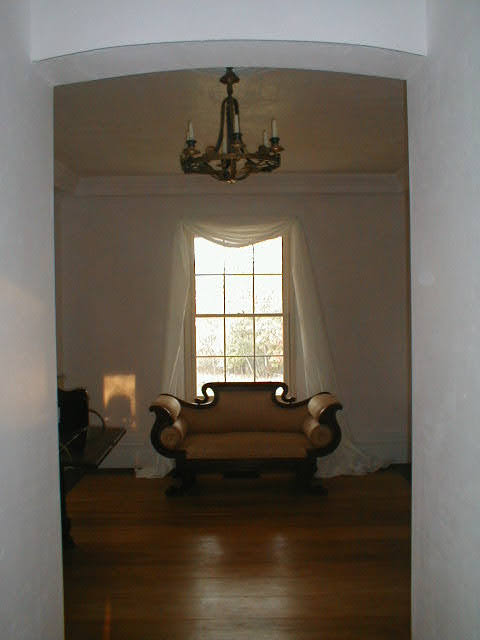
Positioned above the road and utility lines, it offers what William Hamilton, in the New York Times Magazine, called "a perfect view of a previous century." Hamilton used this view as a metaphor, ending his essay with the image of the window as "a powerful telescope" through which Carter was "finally allowing himself to see space become time." It is a beautiful image, but it is also, in an architectural and historical sense, literally accurate.
The Greek Revival landscape of the Hudson Valley — the landscape that Carter had spent his professional life studying, restoring, and preserving — is visible from that window. Montgomery Place is a few miles upriver. Edgewater is nearby. The farms and estates and village houses that make Dutchess County one of the most architecturally coherent landscapes in America are spread across the valley below. From the oculus — the same geometric form Carter had laid out in blue ink on Drawing 78, with twenty-four radiating muntins, before any glass was cut — these buildings and the landscape they inhabit can be seen as what they actually are: not ruins of a dead tradition, but members of a living one, a tradition that includes, now, the house in which the observer stands.
This is the claim that Sneaker's Gap makes on architectural history, and it is a substantial one. The Greek Revival in the Hudson Valley was the product of a specific convergence: an intellectual tradition (the classical orders, transmitted through pattern books), a constructional culture (the builder-architects who knew how to execute what the books specified), a landscape (the river valley with its hillside sites, its limestone and fieldstone, its productive farms), and a social aspiration (the democratic classicism that Asher Benjamin and the founding generation had identified as the appropriate architectural expression of American self-governance). All four elements of this convergence were present in Barrytown in 1989, in the person of a single builder who had the proportional mathematics, the constructional knowledge, the local materials, and the genealogical connection to the tradition. The result is the last pattern-book house in America — not as an elegy for a dead tradition, but as proof that the tradition is not, in fact, dead.
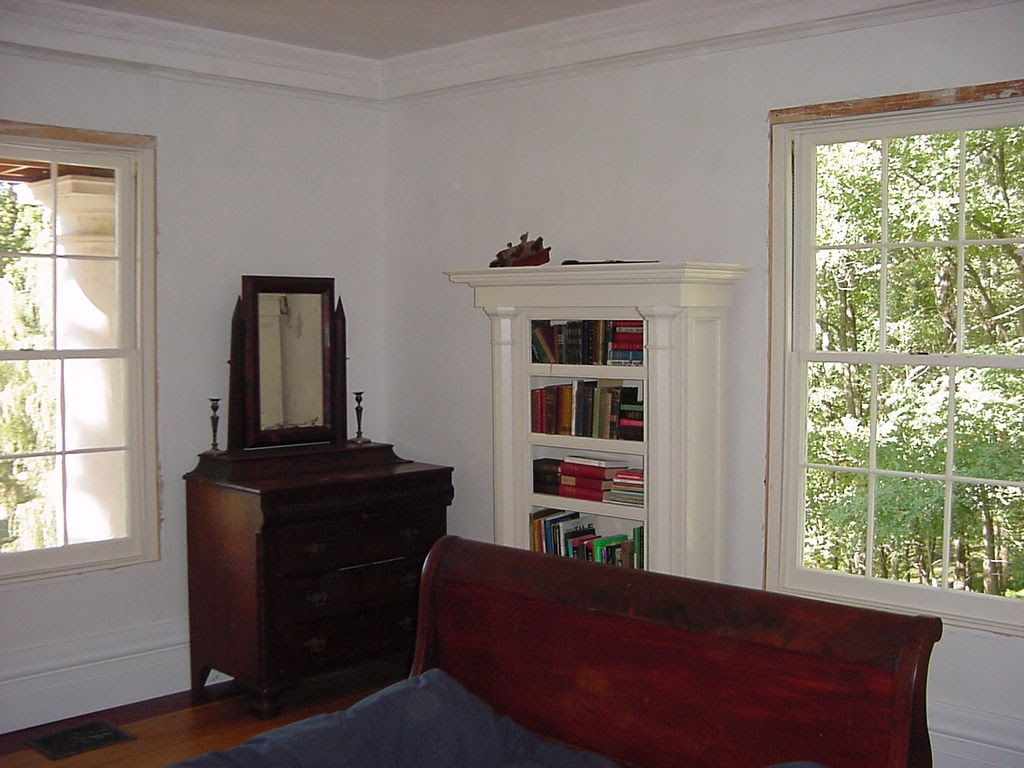
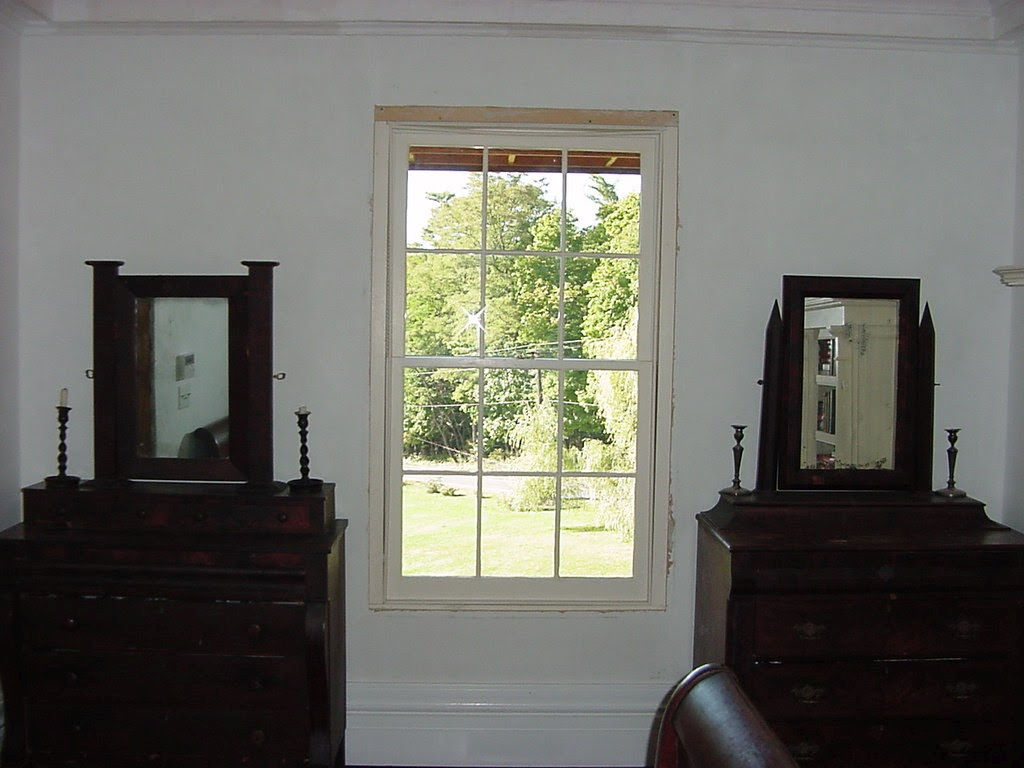
The scholarly literature on American vernacular architecture has established that the Greek Revival spread through the American landscape as much through builder knowledge and pattern books as through trained architects.
.jpg)
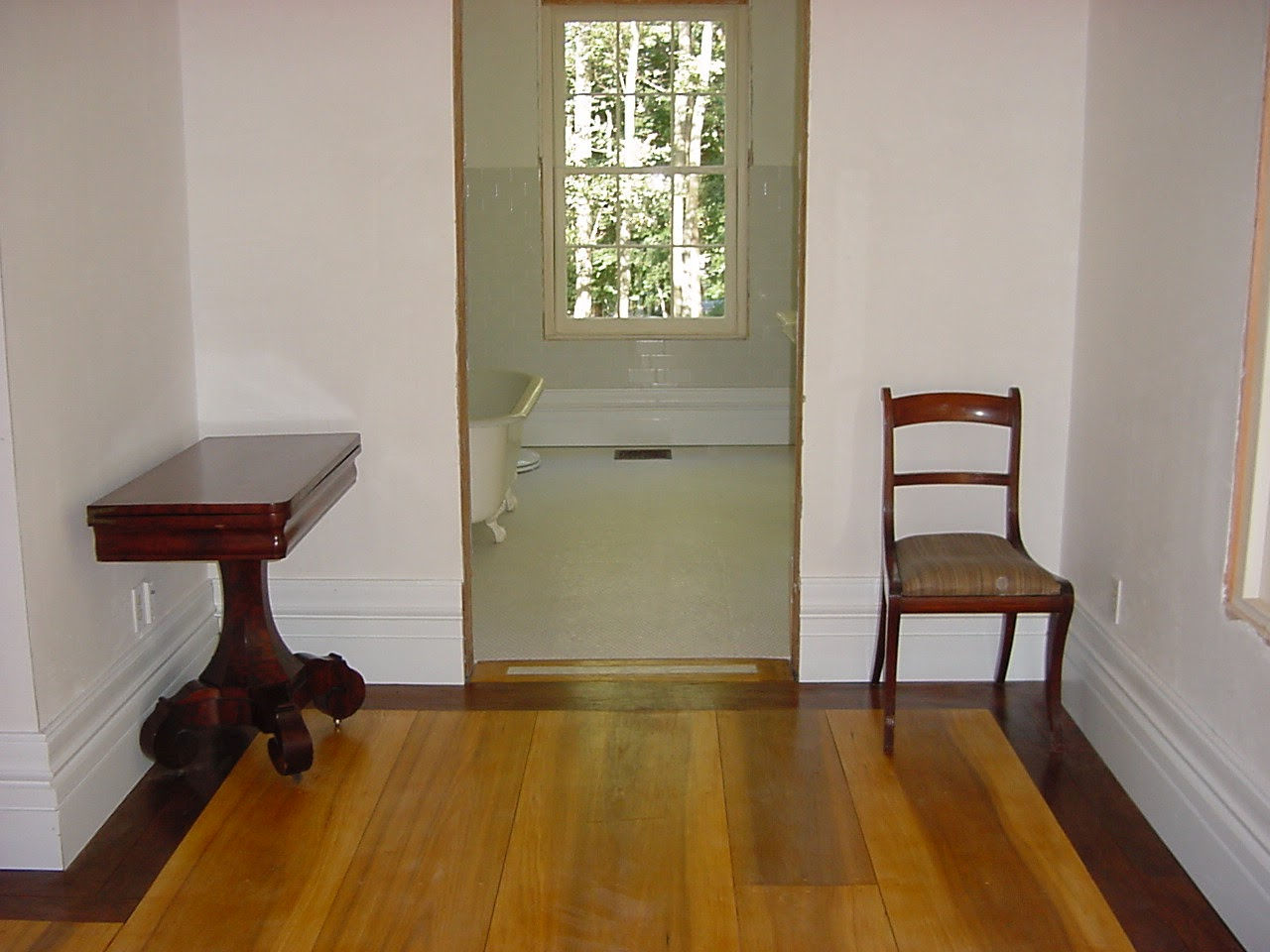
The Asher Benjamin tradition was precisely a vernacular tradition in this sense: it made classical proportion available to people who had not studied at the École des Beaux-Arts and never would. Carter's project is the terminus of that tradition — not in the sense of ending it, but in the sense of following it to its logical conclusion: a builder who took Benjamin's book seriously enough to live inside its proportional system for a decade, who cast his own bricks and milled his own lumber and mixed his own stucco, who inherited his ancestor's tools and used them on his own house, and who is still, as of the last documentation, building.
As Sneaker's Gap was winding down around 2010, Carter left Historic Hudson Valley and went to work for the Architect of the Capitol — the federal officer responsible for the maintenance, operation, and preservation of the United States Capitol complex. Stephen Ayers, the Architect of the Capitol, called Carter personally. The connection came through Jean Parvin Bordewich, Carter's neighbor in Barrytown, who had run Senator Charles Schumer's Hudson Valley operation from 2000 to 2006 and gone on to serve as staff director of the Senate Rules Committee and oversee the Obama-Biden inauguration in 2013. Her husband is Fergus Bordewich, the historian. The same hamlet that had produced a Greek Revival house built by hand from a 1827 pattern book also produced the Senate staffer who opened the door to the United States Capitol. Barrytown is a small place. It does more than most people know.
No one understood this more completely than George W.S. Trow. Trow came to Sneaker's Gap at least seventy times over the twenty years of his friendship with Carter — not as a critic or an observer but as someone who grasped, from inside, what the project meant. His Within the Context of No Context (1981; expanded 1997), first published in The New Yorker under William Shawn — whose editorial genius had recognized what Trow was doing and given it the magazine's most serious platform — argued that American culture had lost its capacity for historical self-location, that the collapse of genuine hierarchy and inherited standard had produced a civilization operating at the scale of celebrity rather than culture, weightless and context-free. Carter met Shawn in New York during the construction years, through Trow. Trow came from a publishing world background — his father had been at the Herald Tribune — and he had always ridden the edge between the world that had existed and the world that had replaced it, writing about the loss of context with the precision of someone who had known the thing being lost. He would put Sneaker's Gap within the context of old New York. He loved the house. He came back seventy times because it was, in his terms, the intellectual positive of which his own work was the negative: a building that insisted on locating itself in historical time, that refused the weightlessness of contemporary construction, that was made by hand from a book written in 1827 by a man whose descendant was building it now. It was all context, nothing but context, context going down to the mortar joint.
Trow died in Naples in 2006. Before he died he called Carter from a pay phone in Italy on a twenty-dollar phone card. Before the card ran out, he said: Geoff, you're the most important man in America.
Then the line went dead.
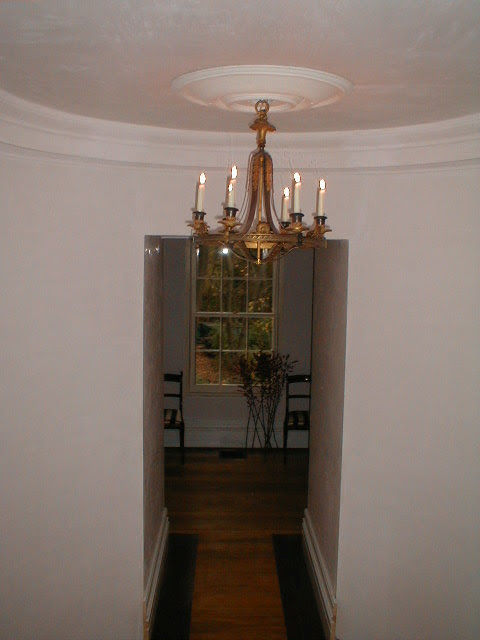
It is worth noting, in conclusion, what Sneaker's Gap is not. It is not a perfect building. The drawing archive records the compromises, the unbuilt ambitions, the designs that were superseded. It is not a building that has been completed. And it is not a building that claims to be historical; it is entirely and explicitly a new building, designed in 1987–1994 by a man who was fully aware of the historical moment in which he was working.
What it is, is something rarer and more important than any of those things would have been. It is a building that takes the classical tradition seriously at the level of making — not of image, not of quotation, not of academic correctness, but of the physical process by which classical architecture has always been produced, and which the tradition has always understood to be inseparable from the architecture's meaning. When Vitruvius wrote that architecture required firmitas, utilitas, venustas — stability, utility, beauty — he was describing not three independent values but a single integrated condition: a building is beautiful because it is stable, it is stable because it is made correctly, and it is made correctly because the builder understood what he was doing at every level, from the proportional mathematics to the mortar joint. Sneaker's Gap was made in that spirit. The archive of 151 drawings proves it. The house itself, rising from its fieldstone foundation on a hillside above the Hudson, is the evidence.
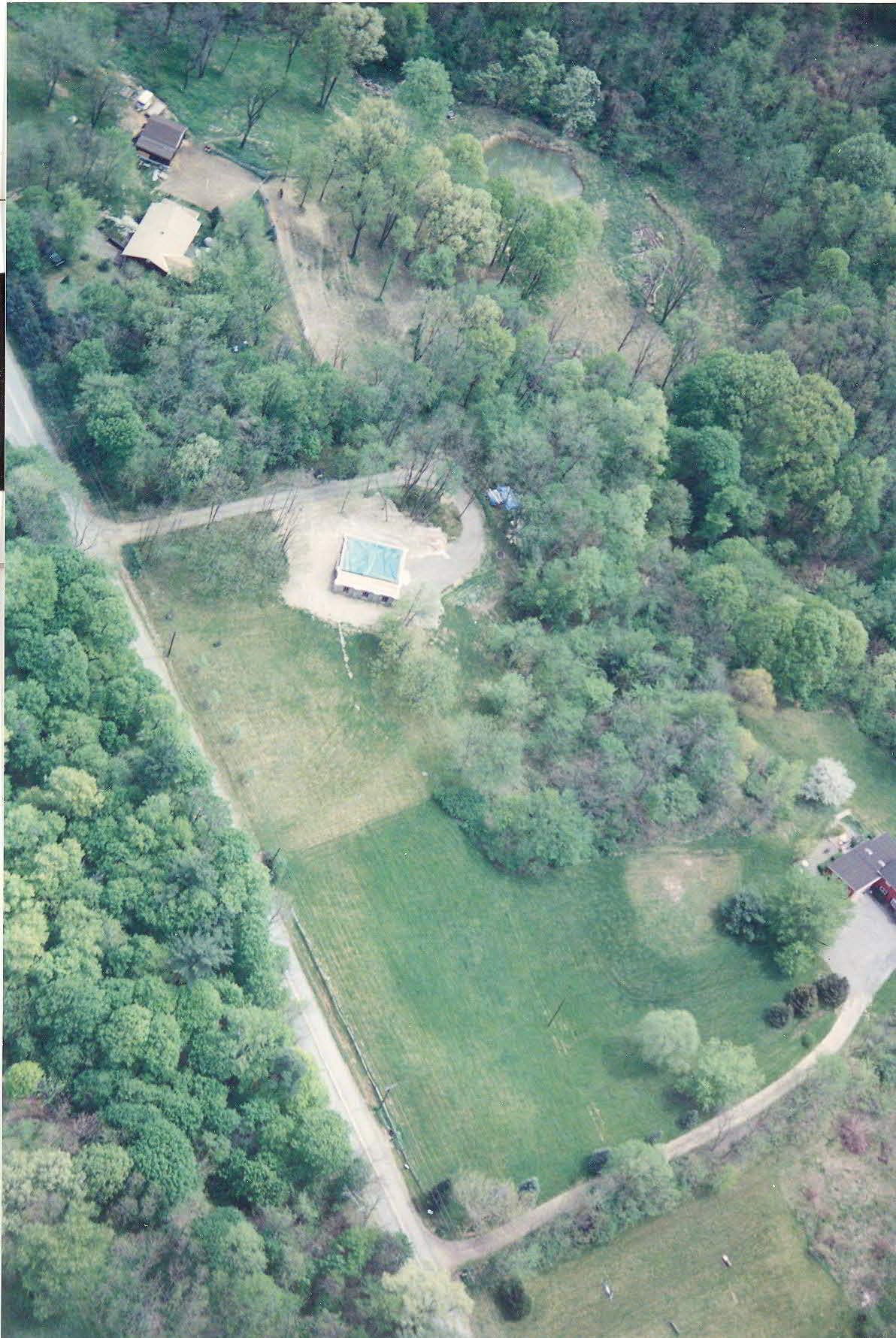


| Element | Specification | Source |
|---|---|---|
| Classical Order | Roman Doric after Asher Benjamin, The American Builder's Companion, 1827 edition | Drawing 103; Drawing 41 field notes |
| Governing Module | One Minute = .443" (7/16"). Height of West Portico Order: 24'; Column height: 19'11-1/4"; Diameter at base: 2'2-9/16" | Drawing 103 (West Portico Specification) |
| East Façade Colonnade | Four full-height Doric columns; total façade width 40'; column diameter at base 10.5", at neck 8-5/8"; stucco surface finish | Drawing 16 (Master East Elevation) |
| Column Construction | 1,800 circular concrete bricks cast in spring-form frames; entasis achieved by calibrated mortar joint reduction; Portland cement, sand, and lime stucco finish; 3-coat application | Drawings 6, 132–133; House & Garden 2002 |
| Ornamental Guttae | 312 conelike ornaments cast in white cement in Dixie cups; 63 triglyphs hand-sanded | NYT Magazine 1995; House & Garden 2002 |
| Pediment Oculus | Elliptical form with 24 radiating muntins in sunburst pattern; geometric layout produced at full scale before fabrication | Drawing 78 (sole oculus layout drawing) |
| Foundation System | Slip-form fieldstone and rubble wall, 18" thick; 36"×14" reinforced concrete footing at 42" below grade; fieldstone from Rhinebeck field, 67 round-trips; deed recorded December 18, 1986, Liber 1729, page 610 | Drawings 93–109; Carter Deed, Dutchess County Clerk's Office |
| Structural Review | Professional engineer Paul J. [surname], NYS License #051459, stamped three drawings: West Elevation (March 18, 1989), First Floor Plan (March 31, 1989), North-South Section | Drawings 66, 121, 131 |
| Floor Plan (First Floor) | Parlor 12'×26'11"; Main Hall 12'×26'10"; Kitchen 12'×16'-0.5"; Dining Room 12'×11'3"; total interior width 27'10"; curved central stair, two fireplaces | Drawing 67 (engineered construction document) |
| Roof | Raised-seam terne metal roofing; rosin paper; 30 lb felt; 5/8" sheathing; 2×12 rafters 16" O.C.; R-30 blanket insulation; pitch 4.868 | Drawings 19, 54, 98 (roof pitch calculation) |
| Interior Finish | Three-coat plaster walls; shellacked tulip poplar floors; hemlock and white pine stairs; herringbone brick in kitchen; 6-panel doors; Carter-fabricated millwork using profile bits from Montgomery Place restoration | Drawings 51, 64 (legends); ICAA 2009 |
| Site | 2.250 acres; County Road No. 82, Town of Red Hook, Dutchess County, NY; purchased December 15, 1986 from Robert E. and Margaret Smith; house footprint 90' from road | Carter Deed; Drawings 59, 115 (survey maps) |
| Drawing Archive | 151 drawings and documents, 1987–1994; G. Carter and G.B. Carter & Stephen Falatko AIA Architects | Carter Drawing Catalog, Drawings 1–151 |
On the toponym "Sneaker's Gap": the primary print record is The Barrytown Explorer (1958–1982), edited by Chanler Chapman ("Bim") of Sylvania estate. The Dutch Snik etymology and Depression-era camp use are documented in the Bard College Oral History Project (Special Collections) and in the boundary research of John Winthrop Aldrich, private papers, Dutchess County Historical Society. For Robert Kelly's treatment of the Gap as a mythic threshold, see his poetry collections mapping the Barrytown landscape, including The Common Shore. Carter's personal connection to Chapman: Carter knew Chapman through the Aldrich family at Rokeby, where he had lived earlier in the Barrytown years; around 1980, while living at the octagon house in Rhinebeck, he rebuilt the cottage at Sylvania that Chapman's son Robert burned down smoking in bed. Phil Almsbach, Barrytown neighbor and Navy veteran: his service included tending mules at Pearl Harbor, which he spoke of at length. The fire department incident — Carter burning brush during construction, Almsbach calling it in, Carter hiding in the ravine — is the Gap functioning as a literal sneaker's gap.
On Asher Benjamin and the pattern-book tradition, see Abbott Lowell Cummings, Rural Household Inventories (Boston, 1964); Dell Upton and John Michael Vlach, eds., Common Places: Readings in American Vernacular Architecture (Athens, GA: University of Georgia Press, 1986); and William H. Pierson Jr., American Buildings and Their Architects: Technology and the Picturesque (New York: Doubleday, 1978). Benjamin's The American Builder's Companion went through six editions between 1806 and 1827; it is still in print, as Carter noted in 1995.
The de-skilling of American residential construction in the twentieth century is documented in David Nye, America as Second Creation (Cambridge: MIT Press, 2003) and, from a craft perspective, in Richard Sennett, The Craftsman (New Haven: Yale University Press, 2008). Sennett's argument that making and thinking are inseparable — that tacit knowledge of materials is a form of intelligence — provides a theoretical framework for understanding what Carter's method achieves that the simple language of "revival" cannot supply.
Martin Filler, "Greek Revival Inch by Inch," House & Garden, November 2002, pp. 106–113. Filler was at this time one of the most authoritative architecture critics in the American press. His assessment of Carter as having surpassed the academic classical revival in authenticity of execution is particularly significant given his broad familiarity with the movement's practitioners.
Geoffrey B. Carter, résumé, January 30, 2011. Education section: "Baccalaureate of Arts, Goddard College, Plainfield, Vermont — Participation in Design and Construction Program (David Sellers, Program Director)... Poetry (Louise Glück, Tutor)." For David Sellers and the Prickly Mountain design-build community, see the Yestermorrow School archives, Warren, Vermont. For Louise Glück's Nobel Prize in Literature (2020), see the Nobel Foundation announcement, October 8, 2020. Carter's simultaneous formation in construction and in poetry under two figures of lasting consequence is not incidental to the essay's argument: the attentiveness to language that Glück's teaching demanded is continuous with the attentiveness to proportion that Sellers' demanded, and both are continuous with the quality of Carter's own writing about his project.
The slip-form fieldstone technique has no standard published description in contemporary construction manuals, which is precisely why Carter had to invent his own documentation system for it. The color-coded drawing suite (Drawings 93–109) constitutes what is likely the most complete extant documentation of the technique as applied to residential construction. For historical context on fieldstone construction in the Hudson Valley, see Myron S. Teller, The Early Homes of New York and the Mid-Atlantic States (New York: Hastings House, 1955).
"Doors Open for Architecture Buffs This Weekend," Times Herald-Record (Newburgh, NY), July 25, 2003. The article documents Carter's role leading tours of Davis outbuildings at Montgomery Place as part of the A.J. Davis bicentennial celebration. Carter's résumé lists the Montgomery Place restoration ($6.5 million, architects John Mesick and Beyer Blinder Belle), the Swiss Factory Lodge restoration ($400,000, architect Stephen Tilly), and infrastructure installation ($1.1 million, architect Stephen Tilly) as among his principal projects at Historic Hudson Valley.
On Samuel Thomson's Mount Washington estate in Inwood: archival records from My Inwood and the New York Historical Society confirm Thomson's 1835 purchase from the Dyckman family. For Thomson's New York City building career, see Landmarks Preservation Commission, "Federal Hall National Memorial," Designation Report (New York: LPC, 1965). Geoffrey Carter, "Samuel Thomson: Prolific New York Builder," Preservation League of New York State Newsletter, Fall 1991 — the only scholarly account of Thomson's career, written and published simultaneously with the construction of Sneaker's Gap, identifying Carter in its byline as "Director of Preservation for Historic Hudson Valley in Tarrytown and a descendant of Samuel Thomson." The Delafield genealogical connection: J. Dennis Delafield, letter to Geoffrey Carter, January 20, 1992, disclosing the Wetmore family connection between Carter's third grandfather and Montgomery Place.
Ian H. Fraser, President, Board of Trustees, New York City Marble Cemetery, letter to Geoffrey Carter, November 20, 2009. The letter confirms Carter's ownership of the Thomson family vault and offers to send the full interment and ownership records. The cemetery is located on Second Street between First and Second Avenues, Manhattan. The Board of Trustees at the time of writing included Helen D. Roosevelt as Secretary and Andrew E. Roosevelt and Andrew W. Roosevelt as trustees. The letter is in Carter's possession.
Richard Crowley, architect and co-founder of Hudson River Heritage (1973), was primarily responsible for achieving the Hudson River National Historic Landmark District designation in 1990. Carter consulted Crowley during the column design process after both the five-column west façade scheme (Drawing 34, marked "Superseded" in pink ink) and an uneven four-column arrangement had been rejected. Crowley's advice confirmed the final evenly-spaced four-column arrangement that appears in all subsequent drawings and in the finished building. Crowley is listed in Carter's contacts as Richard Crowley, P.O. Box 483, Rhinebeck, NY.
Patricia Leigh Brown, "Architecture's Young Old Fogies," The New York Times, February 9, 1995, p. C1. The article remains the most comprehensive single journalistic account of the classical revival moment. Thomas Gordon Smith's visit to Sneaker's Gap with Falatko is confirmed in Carter's contacts database (c. 1996): "Tomas Gordon Smith / 1903 Dorwood / South Bend IN 46617 / Was in NYTimes Article — Visited House with Steve." This places the Notre Dame dean among those who made the pilgrimage to the half-built house in Barrytown.
Polshek's comments appeared in Brown, "Architecture's Young Old Fogies," 1995. For a more sympathetic account of the theoretical stakes of the classical revival, see Vincent Scully's comments in the same piece. Scully's observation that classicism "speaks fundamentally to what people want, to security and dignity and permanence" is consistent with Carter's own philosophical account of his project but does not capture its specifically constructional dimension.
Dell Upton and John Michael Vlach, eds., Common Places (1986). Upton's concept of "polite" and "vernacular" architecture as interpenetrating rather than opposed is directly relevant to Sneaker's Gap, which operates in both registers simultaneously: it is vernacular in its constructional methods and materials, polite in its proportional system and classical vocabulary. George W.S. Trow (1943–2006): his Within the Context of No Context was first published as an essay in The New Yorker in 1980 under editor William Shawn, then as a book by Atlantic-Little, Brown in 1981, with an expanded edition in 1997. Trow's father, George W.S. Trow Sr., had a career in American journalism and publishing — the family background that gave Trow his intimate knowledge of the world whose passing he documented. Carter met William Shawn through Trow during the construction years. For Trow's later years and death in Naples, see the obituaries in The New York Times (November 24, 2006) and The New Yorker. His address during the Sneaker's Gap construction years — Box 127, Germantown NY 12526 — appears in Carter's contacts database.
Richard Hampton Jenrette (1929–2019): co-founder of Donaldson, Lufkin & Jenrette; founder of Classical America; owner of Edgewater (Barrytown, 1820, remodeled 1863), Roper House (Charleston), and Milford Plantation (Sumter County, South Carolina, 1841, architect Nathaniel Potter) — among the most significant collections of Greek Revival domestic architecture in private hands in America. Carter's evaluation of Milford before Jenrette's purchase placed him in a professional relationship to the acquisition of one of the supreme Greek Revival interiors in the country. John H. Dobkin (b. 1942): director, National Academy of Design, 1978–1989; president, Historic Hudson Valley, from 1990 — Carter's direct superior during the Sneaker's Gap construction years. Joan K. Davidson (1927–2023): president, J.M. Kaplan Fund, 1977–1993; New York State Parks Commissioner and State Historic Preservation Officer, 1993–1995. Her house at Midwood, Tivoli, New York, was the site of numerous dinners with Carter over their twenty-year friendship. Carol Ash: New York State Parks Commissioner and State Historic Preservation Officer, 2006–2010; visited Sneaker's Gap during her tenure. David Flaharty: author, Preservation Brief No. 23, "Preserving Historic Ornamental Plaster" (National Park Service, 1990); master craftsman for the Metropolitan Museum of Art and the United States State Department; came to Sneaker's Gap to examine the plaster medallions. William D. Reiley, landscape architect, Charlottesville, Virginia: facilitated Carter's September 1988 visit to UVA, Monticello, and Poplar Forest; listed in Carter's contacts at 109 2nd Street S.E., Charlottesville. The trip is documented in four letters Carter wrote on September 9, 1988, from Historic Hudson Valley letterhead: to James Murray Howard, PhD AIA, Department of Physical Plant, University of Virginia (thanking him for showing Carter and Julie Pavilions 1 and 10); to Lynn A. Beebe, Executive Director of Poplar Forest (thanking her for allowing a visit on a "closed" day and noting that "it seems your project is about to cross the threshold from study to physical intervention"); to Nicholas A. Pappas, FAIA, Colonial Williamsburg Foundation (thanking him for a behind-the-scenes tour of Shields Tavern); and to Reiley himself. Carter described Poplar Forest — then untouched, before restoration had begun — as "a particularly exciting phase." All four letters are in Carter's possession. Jean Parvin Bordewich: ran Senator Charles Schumer's Hudson Valley operation 2000–2006; served on the Red Hook Town Board for nine years; subsequently staff director of the Senate Rules Committee and organizer of the 2013 Obama-Biden inauguration. Her husband is the historian Fergus M. Bordewich. Stephen Ayers: Architect of the Capitol, 2010–2016; called Carter personally in connection with his work for the Architect of the Capitol's office as Sneaker's Gap was winding down.
John H. Dobkin, letter to Richard H. Jenrette, October 23, 1992. Dobkin, as President of Historic Hudson Valley, wrote to Jenrette following Ambassador Walter Annenberg's tour of Montgomery Place and Edgewater. The letter records Annenberg's telephone call to Dobkin, his detailed account of the house room by room, his $25,000 contribution to the south wing restoration, and his assessment of Carter: "Geoff Carter was total quality." The letter is in Carter's possession.